By | Rahul Varde
Growing Concerns Over Construction Waste
The Maharashtra Pollution Control Board (MPCB) has raised an urgent demand for an updated regulatory framework to control the mounting problem of construction and demolition waste across major cities. With redevelopment work expanding rapidly in Mumbai, Navi Mumbai and surrounding urban belts, environmental stress and unmanaged debris have emerged as major concerns affecting public health and city infrastructure.
Air Pollution Impact and Alarming Trends
Recent environmental studies in Mumbai and its satellite towns have highlighted that air pollution spikes are strongly linked to construction dust, earth excavation and illegal dumping of building materials. During peak redevelopment activity, air quality indices deteriorate sharply, driven by PM10 and dust particles spreading from open construction sites and unregulated transport of debris. Officials warn that unless waste is collected, processed and recycled through scientific systems, Maharashtra’s metros will continue facing dangerous air quality episodes and shrinking landfill capacity.
Push for New Regulatory Mechanisms
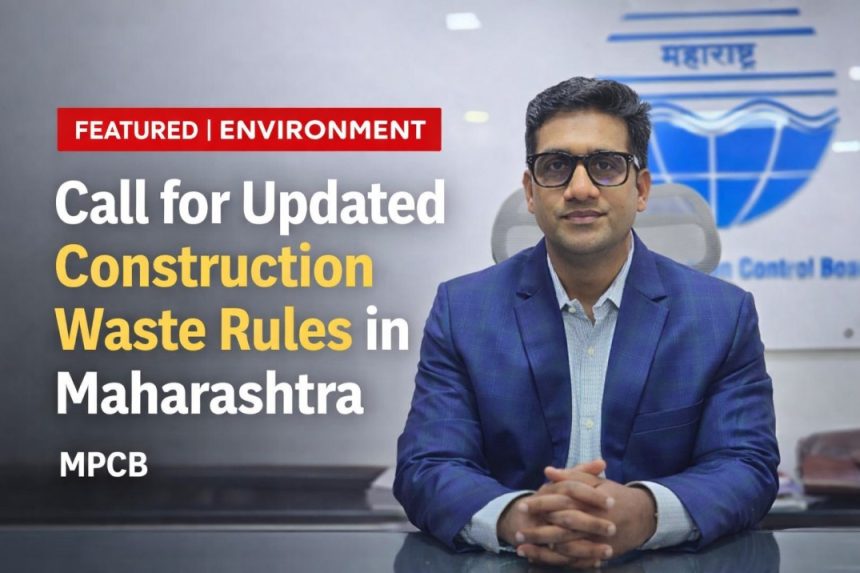
Speaking at a state-level conference in Navi Mumbai focusing on circular economy practices, MPCB Member Secretary M. Devendra Singh stated that existing rules are inadequate for today’s scale of redevelopment. He said construction companies and contractors must shift toward stricter compliance systems backed by technology, ensuring waste is no longer dumped but treated as a resource that feeds back into the building cycle. Singh noted that circular methods are essential not just for controlling pollution but for long-term sustainability in dense urban regions.
India’s First 850 White-Category Unit Approval
In one of the most significant recent reforms, Singh announced that Maharashtra has granted nominal regulatory clearance to 850 units under the ‘White’ classification, marking the first instance in India where such a large cluster has been shifted simultaneously. The White category is reserved for low-impact units with minimal emissions, requiring far fewer permissions. The step reflects growing industry cooperation and is expected to bring a major portion of operations into cleaner monitoring structures.
Citizen Activists Intensify Scrutiny
Alongside government efforts, public pressure has also played a decisive role in shaping policy decisions. Social reform groups, local environment movements and citizen coordinators have regularly highlighted illegal dumping locations, recorded dust violations on roads and petitioned authorities for action. Their interventions—ranging from community drives to email complaints and digital campaigns—have compelled agencies to tighten enforcement. Officials acknowledged that on-ground vigilance by residents has helped close compliance gaps and raised broader awareness about air pollution and waste management.
Collaborative Action Toward Cleaner Cities
Experts, engineers, municipal officials and industry representatives participated in the conference and exchanged insights on practical waste-recovery systems, enforcement tools and new recycling technologies. Singh reiterated that future urban development must be carried out without compromising the environment and stressed that Maharashtra, home to India’s largest cluster of redevelopment projects, must lead the national transition toward cleaner and more sustainable construction practices.
Roadmap for the Coming Months
Authorities are expected to frame strengthened guidelines ensuring real-time dust control at construction sites, the use of covered transport vehicles to prevent road contamination, and mandatory routing of all debris to authorized recycling facilities. Officials also indicated that penalties for non-compliance could increase as part of the new framework. The state believes that the cleaner-city mission will depend equally on policy enforcement, innovation from the building sector and continued cooperation from aware citizens.