

Uddhav–Raj Press Conference Signals Political Shift
By | Arvind Jadhav
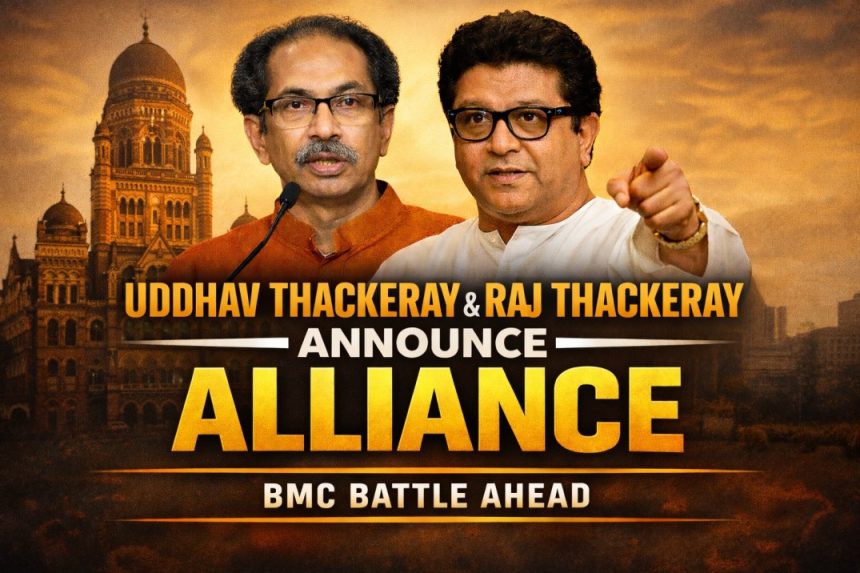
Mumbai -In a major political development, Shiv Sena (UBT) chief Uddhav Thackeray and Maharashtra Navnirman Sena (MNS) president Raj Thackeray appeared together at a press conference in Mumbai today, fuelling strong speculation about a formal political alliance. The joint appearance marked the first such public interaction between the cousins in nearly two decades and sent a clear message of reconciliation and strategic unity.
Statements Emphasise Unity and Maharashtra’s Interests
Addressing the media, Uddhav Thackeray stated that the time had come for Marathi leaders to stand together to protect Maharashtra’s interests, language, and cultural identity. He stressed that division among Marathi forces only benefits political rivals and weakens the state’s voice.
Raj Thackeray echoed similar sentiments, asserting that unity was necessary for long-term political stability. He stated that the decision to come together was not temporary or election-centric but aimed at creating a strong and united front for Maharashtra’s future.
Symbolic Gesture Strengthens Alliance Narrative
Before the press conference, both leaders paid tribute at the memorial of Shiv Sena founder Balasaheb Thackeray, a gesture seen as emotionally and politically significant. Political observers view this as an attempt to reconnect with the ideological roots of the original Shiv Sena while appealing to long-time supporters of the Thackeray legacy.
Background: Two Decades of Political Separation
Uddhav and Raj Thackeray parted ways in 2005 due to ideological and organisational differences, leading to the formation of the MNS. Since then, both parties have operated independently, often dividing the Marathi vote, particularly in Mumbai and other urban regions. Over time, changing political equations and recent electoral trends appear to have pushed both leaders toward reconsidering their rivalry l.
Opposition Leaders Question Intent and Stability
The possible alliance has triggered strong reactions from opposition parties. BJP leaders have termed the move opportunistic, questioning its ideological consistency and timing. They argue that the alliance is driven more by political survival than by public interest.
Leaders from Congress and other opposition groups have taken a cautious approach, stating that while the alliance may influence urban politics, its long-term stability will depend on leadership coordination, seat-sharing clarity, and internal unity.
Political Impact and Road Ahead
If formalised, the Uddhav–Raj alliance could significantly reshape Maharashtra’s political landscape, especially in civic elections in Mumbai, Thane, and Pune. Analysts believe a united Marathi front could emerge as a decisive force against established political blocs.
Party workers and supporters now await clarity on the alliance structure, electoral strategy, and leadership framework. The coming weeks are expected to be crucial in determining whether this reunion evolves into a lasting political partnership