


China Sets New World Record in High-Speed Maglev Technology
By | Kalyani Mandle | PR Desk
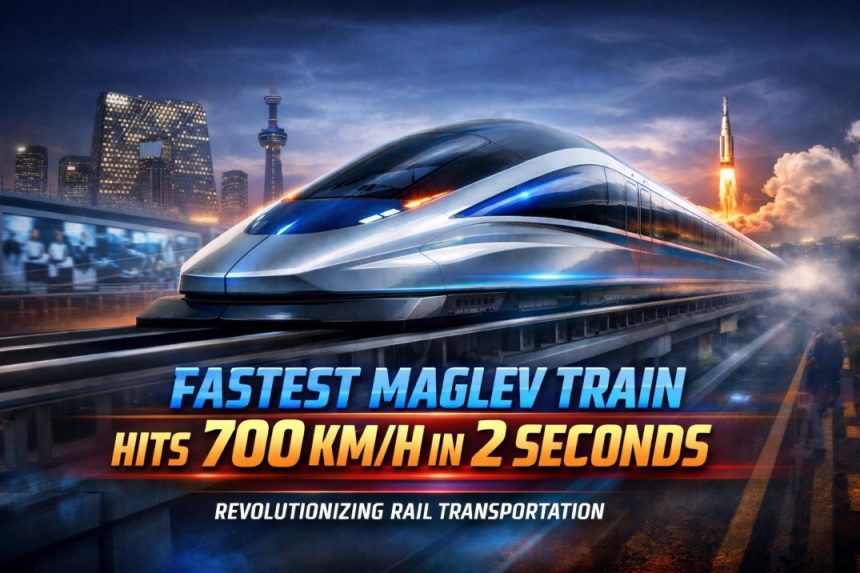
Mumbai: China has achieved a major breakthrough in ultra-high-speed transportation, setting a new world record by accelerating a magnetic levitation (maglev) test vehicle to 700 kilometres per hour in just two seconds on a short experimental track. The trial, conducted on a 400-metre test line by researchers at the National University of Defense Technology, showcased unprecedented acceleration and marked the fastest speed ever recorded for a superconducting electric maglev system. The vehicle, weighing about one tonne, reached its peak speed and was brought safely to a halt, demonstrating not only remarkable acceleration but also control and stability at extreme performance levels. This milestone places China among the global leaders in ultra-high-speed rail research, with implications far beyond conventional train travel.
A Decade of Maglev Research and Technical Triumphs
This record is the result of over a decade of sustained research and development in maglev technology, during which scientists tackled key technical challenges such as ultra-high-speed electromagnetic propulsion, electric suspension guidance systems, high-power energy storage and conversion, and the application of high-field superconducting magnets. The success of this initiative reflects China’s long-term investment in advanced transportation systems and its effort to push the boundaries of what magnetic levitation technology can achieve. The new benchmark emerges in a broader context of China’s exploration of even higher speeds and innovative concepts such as vacuum-tube maglev transportation, which could one day revolutionize intercity travel.
Historical Milestones in Chinese High-Speed Rail and Maglev Development
China’s journey in high-speed rail and maglev technology began with the opening of the Shanghai maglev line in 2004, the world’s first commercial maglev service. Using German Transrapid technology, this line connected Shanghai’s Longyang Road station to Pudong International Airport and operated at a top commercial speed of around 430 km/h, setting early benchmarks for high-speed rail in regular service. China’s maglev history also includes earlier experimental test runs in the 2000s and 2010s that steadily pushed speeds higher.
In recent years, the focus shifted back toward ultra-high-speed maglev systems. Chinese developers, including CRRC and various research institutions, worked on prototypes like the CRRC 600 km/h maglev train, unveiled in the early 2020s and designed to test maglev technologies at ever-higher velocities. Trials of these systems helped lay the groundwork for the current record-breaking performance by providing valuable insights into levitation mechanisms, track-vehicle interaction, and propulsion methods.
Alongside maglev projects, China’s conventional high-speed rail network grew into the world’s largest, with flagship models such as the CR400 “Fuxing” trains routinely operating at around 400 km/h on major corridors, dramatically cutting travel times between cities and transforming domestic transport. More recently, advanced conventional designs like the CR450 reached top test speeds of about 450 km/h, reinforcing China’s leadership in both wheel-on-rail and levitation-based transportation.
Looking Ahead: The Future of High‐Speed Travel
China’s latest success in maglev technology underscores the country’s ambition to reshape the future of high-speed travel. By pushing maglev systems to speeds once thought possible only in science-fiction concepts, Chinese researchers are exploring breakthroughs that could eventually enable travel at speeds rivaling aircraft over long distances. As research continues and additional tests are planned, these developments fuel expectations that future maglev and vacuum-tube systems may one day redefine the way people and goods move across vast regions.