


India Enters a New Phase of Carbon Management
By | Shamsher Shaikh
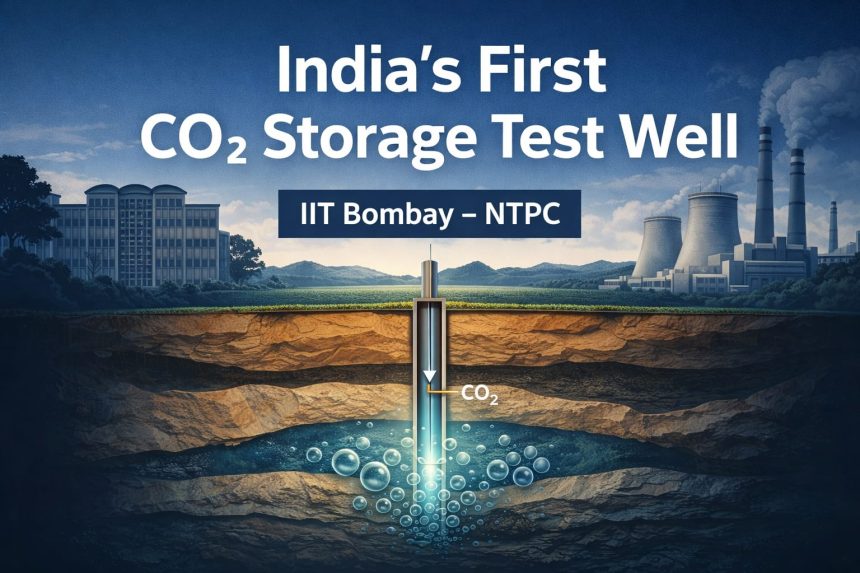
Mumbai ; India has taken a landmark step in its fight against climate change with the successful drilling of the country’s first carbon dioxide (CO₂) storage test well by IIT Bombay in collaboration with NTPC. This breakthrough positions India among a select group of nations actively testing advanced carbon capture and storage technologies to reduce greenhouse gas emissions from large industrial sources.
Understanding the Importance of CO₂ Storage
Carbon capture and storage is considered a critical tool in global climate strategies, especially for industries where emissions are difficult to eliminate. The newly drilled test well will help scientists understand how captured carbon dioxide can be safely injected and stored deep beneath the earth’s surface, preventing it from entering the atmosphere and contributing to global warming.
Role of Geological Formations in Safe Storage
The test well is designed to evaluate underground rock formations that can securely hold carbon dioxide over long periods. Researchers are studying factors such as rock permeability, pressure behavior, and sealing layers to ensure that stored CO₂ remains trapped and does not leak. These studies are essential to determine whether India’s geology is suitable for large-scale carbon storage projects.
Strong Academia–Industry Collaboration
The project highlights the growing collaboration between academic institutions and public sector enterprises. IIT Bombay is providing scientific research, modeling, and monitoring expertise, while NTPC is contributing operational experience and industrial-scale knowledge. This partnership is expected to accelerate the transition of carbon storage research from laboratories to real-world applications.
Supporting India’s Net-Zero and Energy Transition Goals
India has committed to long-term emission reduction targets while continuing to meet rising energy demands. Technologies like carbon capture and storage can help balance economic growth with environmental responsibility. Successful outcomes from this test well could enable cleaner operations at thermal power plants and other emission-intensive industries.
Implications for Power, Cement, and Steel Sectors
Experts believe that carbon storage could play a transformative role in sectors such as power generation, cement manufacturing, steel production, and petrochemicals. These industries contribute significantly to national emissions and require scalable solutions. The data generated from the test well will be crucial in assessing how CCS can be integrated into these sectors.
Advancing Research, Innovation, and Policy Frameworks
Beyond technical evaluation, the project is also expected to inform future policies, safety standards, and regulatory frameworks related to carbon storage in India. It opens new avenues for research, skill development, and innovation in climate technologies, creating opportunities for scientists, engineers, and clean-energy startups.
A Foundation for Large-Scale Climate Solutions
The drilling of India’s first CO₂ storage test well is being seen as a foundational step rather than an endpoint. Authorities and experts view it as the beginning of a broader roadmap that could eventually lead to commercial-scale carbon storage projects, strengthening India’s role in global climate action