

Protests Erupt Over UGC Notification
By | Arvind Jadhav
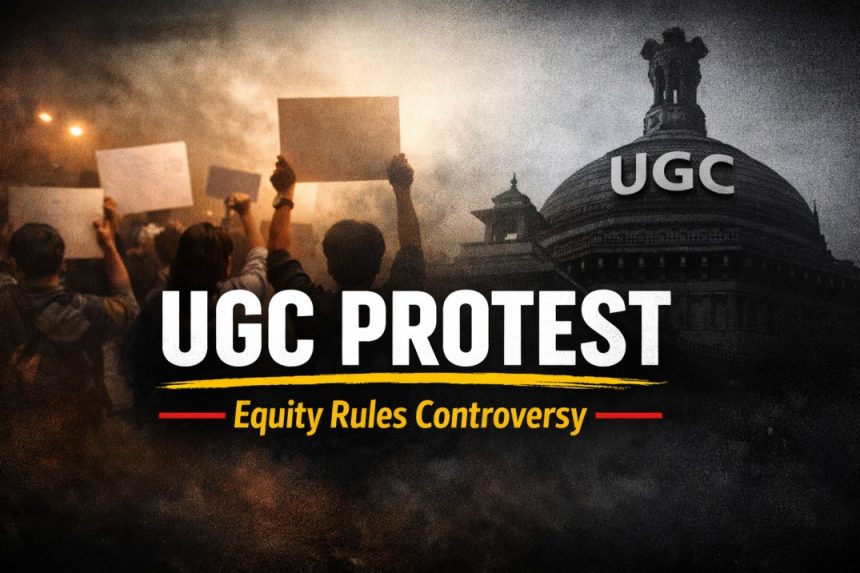
New Delhi: The University Grants Commission’s newly introduced Equity and Anti-Discrimination Regulations 2026 have sparked widespread protests across several states, turning into a major political controversy within days of their announcement. What was projected as a progressive step toward strengthening social justice in higher education has instead opened a new front of political and social confrontation. Student bodies, teachers’ associations and civil society groups have taken to the streets, questioning both the intent and execution of the policy. Campuses that were once focused on academics are now witnessing slogans, demonstrations and heated debates. The issue has also moved rapidly into mainstream politics, with leaders across party lines issuing statements and counter-statements. Several state governments have sought clarifications from the Centre, while opposition parties are demanding a complete rollback. The unfolding developments indicate that the regulations have struck a sensitive chord in society. Education, which is often seen as a tool of empowerment, is now at the centre of a larger ideological battle. The coming days are expected to see further escalation as more stakeholders join the discourse.
What the New Regulations Propose
According to the new framework, all universities and colleges must establish equity committees, equal opportunity cells and internal grievance redressal bodies to address complaints related to discrimination. These bodies will be responsible for receiving, examining and resolving grievances within a stipulated time frame. The regulations also mandate awareness programmes and sensitisation workshops for students and staff. Authorities argue that these measures are necessary to ensure that higher education institutions remain inclusive and safe spaces for all. The UGC has stated that discrimination based on caste, community, gender or social background cannot be tolerated in any form. However, critics point out that similar mechanisms already exist and question the need for an entirely new regulatory structure. They allege that the new rules expand administrative powers without clearly defining limits. This, they say, could create confusion and overlapping jurisdictions. The lack of detailed operational guidelines has added to the uncertainty surrounding implementation.
Students Take to Streets
Soon after the notification was issued, student groups in several states began organising protests. Universities witnessed sit-ins, marches and campus shutdowns as demonstrators demanded withdrawal or major amendments to the regulations. Many students claim that the rules are vaguely worded and open to misuse. There is a growing fear that complaints could be filed without adequate evidence, leading to harassment of innocent individuals. Student leaders have argued that the atmosphere of suspicion created by the regulations could damage trust among peers and faculty members. They also warn that academic freedom may suffer if students and teachers start functioning under constant fear of complaints. Several student unions have announced statewide and nationwide agitation plans. Social media platforms are also witnessing intense debates, with hashtags both supporting and opposing the regulations trending simultaneously. The unrest shows no signs of subsiding in the immediate future.
Main Objections and Legal Concerns
Opposing groups have listed multiple concerns regarding the regulations. They argue that the rules focus heavily on certain categories while failing to provide explicit safeguards for others. The absence of clear penalties for false or malicious complaints has emerged as a major issue. Legal experts have pointed out that principles of natural justice must be clearly embedded in any regulatory framework. Critics also question whether educational institutions are equipped with trained personnel to handle sensitive cases. Without proper training, they warn, grievance bodies may end up taking arbitrary decisions. Another concern is the potential increase in administrative burden on already stretched institutions. Many fear that instead of improving campus harmony, the regulations could deepen social divisions. These apprehensions have added fuel to the growing opposition.
Protests Spread to Multiple States
Demonstrations have been reported from Bihar, Uttar Pradesh, Maharashtra and several other states. In many cities, protesters submitted memorandums to district collectors and governors. Some campuses witnessed temporary suspension of classes as tensions escalated. Police deployment was increased in sensitive areas to prevent law-and-order situations. In a few places, minor scuffles were reported between rival student groups. The widespread nature of the protests indicates that the issue resonates beyond isolated campuses. Regional student organisations have joined hands with national bodies to coordinate agitation. The possibility of a nationwide bandh by student groups is also being discussed. The geographical spread of protests underscores the seriousness of the situation.
Political Lines Clearly Drawn
The controversy has sharply divided political parties. Some parties have welcomed the regulations, calling them long overdue and necessary to protect marginalized students. Others have accused the central government of pushing a poorly drafted policy without adequate consultation. Opposition leaders claim that the regulations are being used to create new vote-bank narratives. Ruling party leaders, on the other hand, argue that the policy is being misrepresented. Internal differences have also surfaced within some parties, with leaders expressing conflicting views. The issue has become a regular feature in political debates and television discussions. Analysts believe that the controversy could influence upcoming elections in several states. Education policy is fast becoming a political battleground.
Centre, UGC Defend Move
The central government and UGC officials have defended the regulations, stating that the intent is purely to strengthen anti-discrimination safeguards. They have urged students and political parties not to fall prey to misinformation. Authorities have indicated that constructive feedback will be considered during the implementation process. However, no concrete timeline for possible amendments has been announced so far. This has left many stakeholders dissatisfied. Government representatives have appealed for calm and cooperation. They maintain that the regulations are in line with constitutional values. Whether these assurances will pacify protesters remains uncertain.
Campuses Face Uncertainty
Universities are currently operating in an atmosphere of uncertainty. Administrators are struggling to interpret the new rules and prepare compliance plans. Academic experts warn that prolonged agitation could disrupt admissions, examinations and research activities. Students preparing for competitive exams fear that the unrest may affect their academic progress. Parents have also expressed concern over the situation. The longer the deadlock continues, the greater the risk of academic loss. Restoring normalcy on campuses has become a major challenge.
What Lies Ahead
The UGC’s new equity regulations, introduced with the stated aim of promoting fairness, have instead triggered nationwide unrest. The debate has exposed deep divisions over how social justice should be pursued in higher education. A balanced approach that addresses discrimination while safeguarding due process appears essential. The coming weeks will be crucial in determining whether dialogue or confrontation will shape the future of this policy.