

A historic trade breakthrough after 20 years
By | Gitanjali Thorat | PR Desk
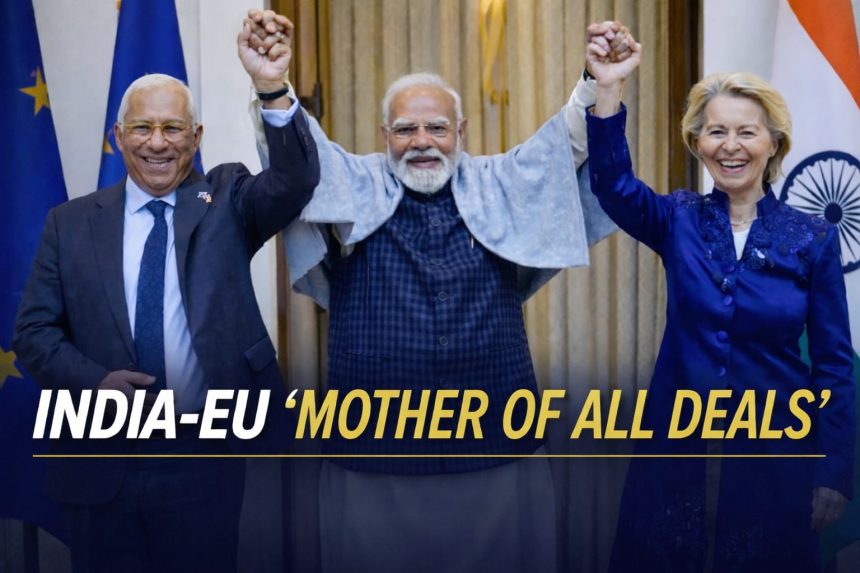
In a major global trade development, the European Union and India have announced a long-awaited free trade agreement after nearly two decades of negotiations. European Commission President Ursula von der Leyen called it the “mother of all deals,” describing the pact as a strategic “win-win” partnership between two major economic blocs.
The agreement impacts a combined market of nearly 2 billion people and economies representing roughly a quarter of global GDP, making it one of the most significant trade deals in recent years.
What the India–EU free trade deal includes
The agreement focuses heavily on tariff reductions, especially in sectors where both sides see clear commercial gains.
Under the pact, tariffs on 96.6% of EU goods exported to India will be reduced or eliminated. This is expected to save European exporters nearly €4 billion annually in customs duties.
India, on its part, will reduce tariffs across key industrial categories such as machinery, chemicals, and pharmaceuticals, opening the door to cheaper imports and stronger supply linkages with Europe.
Automobiles emerge as the biggest winner
The most high-impact component of the deal is the automotive sector.
European carmakers including Volkswagen, BMW, Mercedes-Benz, and Renault will see Indian tariffs on vehicles drop from a steep 110% to as low as 10%, under a structured phased approach.
However, these reduced tariffs will apply under an annual quota of 250,000 vehicles, a number that is reportedly six times larger than the quota offered to the UK in its trade deal with India.
To safeguard domestic manufacturers, India has inserted protections such as:
•Higher tariffs on European cars priced below €15,000
•A five-year grace period for electric vehicles before reduced rates apply fully
This balance signals India’s willingness to open markets—but not at the cost of its local industry.
Wine, spirits and premium European products get major cuts
The deal also includes notable tariff reductions on luxury and premium consumption categories—an area India traditionally protects with heavy duties.
•Wine tariffs fall from 150% to around 20–30% for medium and premium varieties
•Spirits tariffs drop from 150% to 40%
This could reshape India’s premium beverage market while increasing competition for imported brands.
What Europe is giving India in return
The EU is also significantly opening its market to Indian goods.
It will reduce tariffs on 99.5% of goods imported from India, including removal of duties on:
•Marine products (shrimp and seafood)
•Leather goods
•Textiles and garments
•Handicrafts
•Gems and jewellery
•Plastics
•Toys
These are labour-intensive sectors where India has strong competitive advantage and large employment dependence. For Indian exporters—especially those affected by recent global tariff pressures—this market access could provide a major boost.
What’s missing: labour, climate and enforceable environmental rules
Despite its scale, the deal avoids deeper harmonisation in key policy areas.
Crucially, it does not include comprehensive enforceable commitments on:
•Labour rights
•Environmental standards
•Climate obligations
While there are references to the EU’s Carbon Border Adjustment Mechanism (CBAM), the agreement reportedly stops short of strict enforcement frameworks that the EU increasingly pushes in its modern trade deals.
This signals that India is still cautious about trade agreements being used to impose regulatory standards beyond tariffs.
Sensitive European sectors remain protected
Europe has also kept strong protections for politically sensitive agricultural sectors.
The EU continues tariffs on:
•Beef
•Chicken
•Dairy
•Rice
•Sugar
This ensures European farmers remain insulated from competition, even as industrial and consumer goods become freer to move between the two markets.
Why now? The geopolitical timing is not accidental
The announcement comes at a moment when trade is becoming increasingly strategic.
Three forces appear to have accelerated the deal:
1) Diversification away from traditional partners
Both India and the EU are seeking to reduce overdependence on limited trade partners amid global economic uncertainty.
2) The Trump tariff factor
Both sides face pressure from US protectionism:
•India reportedly faces 50% tariffs
•The EU faces 15% headline tariffs, and has faced additional threats
This trade pact provides both India and the EU with alternative market security.
3) Avoiding trade diversion and dumping
With US restrictions tightening, goods—especially from China—risk being diverted into other markets.
Both India and the EU want to avoid becoming dumping grounds for surplus products redirected away from the US.
Part of a wider EU dealmaking spree
The India agreement also fits into a broader EU trade strategy.
The EU recently signed a deal with Mercosur, but that pact has faced legal complications after the European Parliament referred it for review—raising questions about ratification risks.
The EU also finalised negotiations with Indonesia in September, with EU–Indonesia trade reaching €27 billion in 2024.
This trend shows the EU is aggressively building diversified trade networks—particularly in Asia.
Why the India–EU deal matters globally
This agreement is more than economics—it’s a global trade signal.
It indicates that major democracies are responding to protectionism not by shutting down, but by deepening alliances with each other through rules-based trade frameworks.
Even though some key details remain pending and ratification is still to come, the announcement itself sends a message: the EU has options, and it will use them.
For Australia, the India–EU deal could become a catalyst.
Australia already has the Australia–India Economic Cooperation and Trade Agreement (ECTA) in force since 2022. Now, this EU deal increases pressure and momentum to finalise the broader Comprehensive Economic Cooperation Agreement (CECA), under negotiation since 2023.
The 11th negotiation round in August covered:
Goods and services
Digital trade
Rules of origin
Labour and environmental standards
The EU deal suggests India is open to tariff liberalisation—but whether India accepts newer trade themes like labour and climate obligations remains uncertain.
Australia is also pursuing its own EU free trade agreement, talks for which resumed last June after collapsing in 2023.
The EU’s success with India may encourage renewed political will on both sides, especially as nations adapt to a world where trade has become increasingly linked to strategic alignment.