

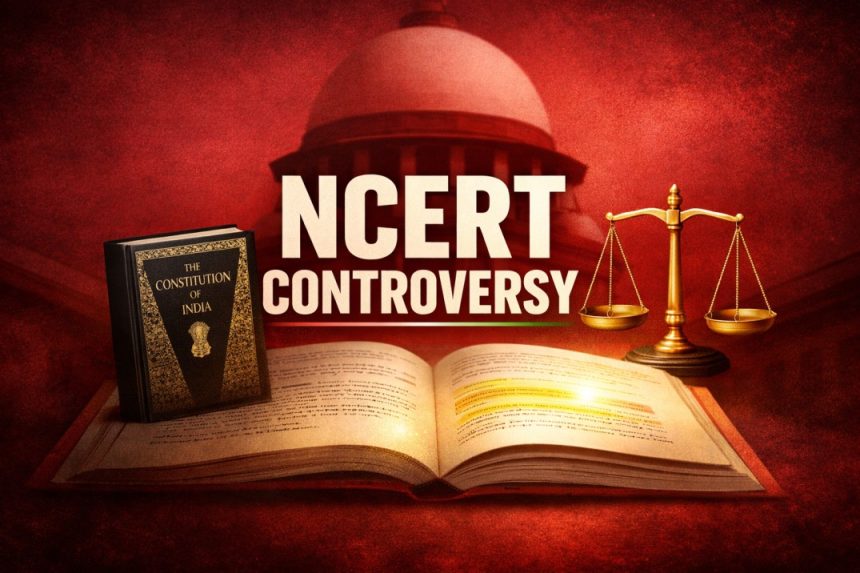
Supreme Court Registers Suo Motu Case Over NCERT Textbook Mentioning Judicial Corruption
By | Arvind Jadhav
In a notable development, the Supreme Court of India has taken suo motu cognisance of concerns arising from content in a school textbook published by the NCERT that referred to corruption within the judiciary.
The court’s decision to initiate proceedings on its own highlights the seriousness with which it views the matter, particularly in relation to public confidence in constitutional institutions.
Court Expresses Concern Over Institutional Image
During preliminary observations, the bench led by Chief Justice Surya Kant emphasized that the credibility of the judicial system is fundamental to democracy.
The court indicated that educational material must present institutional issues responsibly, especially when aimed at school-level students. According to the bench, discussions on governance challenges should be framed in a balanced manner so that they encourage awareness without undermining trust in the justice system.
Focus on Curriculum Responsibility
The issue revolves around a civics chapter that sought to explain the functioning of courts and challenges faced by the judiciary. While the intention may have been to promote civic understanding, the wording reportedly triggered concern over whether it generalized problems in a way that could mislead young readers.
The court is expected to examine whether safeguards are required to ensure that educational content on constitutional institutions is vetted more carefully before publication.
Possible Revision of Content
Education authorities are likely to review the disputed sections of the textbook. Officials have indicated that revisions may be considered to ensure that the material remains informative while maintaining respect for constitutional bodies.
A revised edition of the book may be introduced in future academic sessions after consultation with subject experts and legal authorities.
Broader Implications
The case is being closely watched as it may influence how public institutions are discussed in school curricula across India. The proceedings could lead to broader guidelines on presenting sensitive topics in educational material.
Observers believe the outcome may shape future debates on the balance between civic education, institutional transparency, and respect for democratic structures.