By | Arvind Jadhav
Poll Dates Bring Mumbai Back to the Political Battle
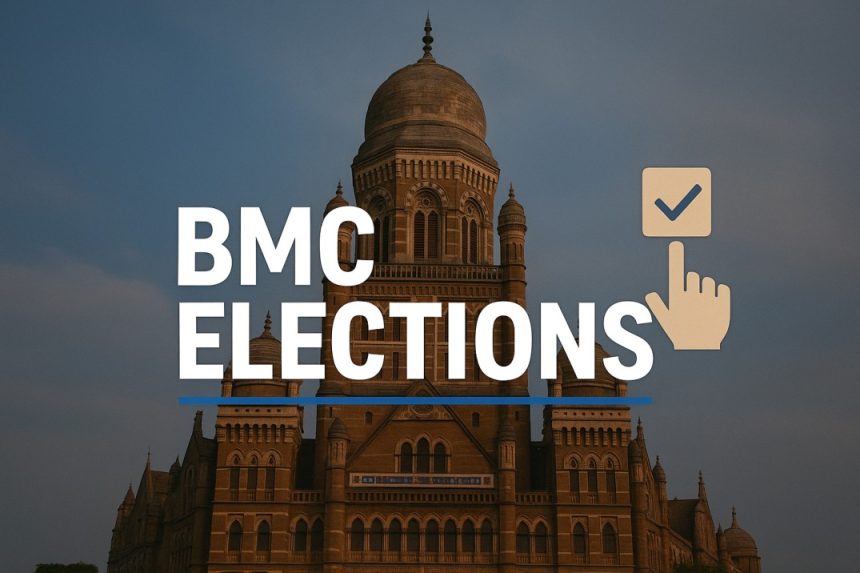
Mumbai: The announcement of the Brihanmumbai Municipal Corporation elections has formally pushed Mumbai into election mode after nearly four years of administrator rule. Polling will take place on January 15, with counting scheduled for January 16, marking the return of electoral politics to India’s richest civic body. More than a routine municipal exercise, the BMC election is being seen as a decisive political event that will shape Mumbai’s governance and influence Maharashtra’s wider political narrative.
Why the BMC Election Holds National Significance
The BMC controls one of the largest civic budgets in the country and is responsible for critical urban services including infrastructure development, health, transport, housing and disaster management. Since 2022, the corporation has functioned without an elected council, a situation repeatedly criticised by opposition parties as undemocratic, while the ruling alliance has maintained that legal and administrative hurdles made the delay unavoidable. With elections now announced, political activity across Mumbai has intensified sharply.
2017 Verdict: A Changed Political Baseline
The 2017 BMC elections remain an important reference point for political observers, though the current contest is far removed from that scenario. In 2017, the undivided Shiv Sena emerged as the single largest party with 84 seats, closely followed by the BJP with 82 seats. The Congress secured 31 seats, the NCP won 9 seats, and the Maharashtra Navnirman Sena managed to win 7 seats. Despite the BJP’s strong showing, the Shiv Sena retained control of the civic body. Since then, the political landscape has undergone dramatic changes, with splits in both the Shiv Sena and the NCP altering traditional vote banks.
Mahayuti Versus MVA: Two Competing Narratives
The upcoming election is largely framed as a contest between the ruling Mahayuti alliance and the opposition Maha Vikas Aghadi. The Mahayuti, consisting of the BJP, the Eknath Shinde-led Shiv Sena and the Ajit Pawar-led NCP, is projecting itself as a stable governing force capable of aligning state and civic administration to accelerate development works in Mumbai. Leaders from the alliance have publicly stated that coordinated governance is essential for completing major infrastructure projects and improving civic services.
Opposition Push: Democracy and Civic Accountability
On the other hand, the Maha Vikas Aghadi, comprising the Shiv Sena led by Uddhav Thackeray, the Congress and the Sharad Pawar-led NCP, is positioning the election as a fight to restore democratic accountability in Mumbai’s civic administration. Opposition leaders have accused the state government of deliberately delaying elections to retain bureaucratic control over the BMC, arguing that elected representatives are essential for transparent and people-centric governance.
BJP–Shinde Sena Equation and Seat-Sharing Tensions
Although the BJP and the Shinde-led Shiv Sena are contesting as allies, seat-sharing discussions between the two remain sensitive. The BJP is seeking a larger share of seats, citing its organisational growth and electoral performance in recent years, while the Shinde faction of the Shiv Sena is eager to establish itself as the legitimate heir to the party’s traditional Marathi strongholds in Mumbai. Political observers note that any imbalance or friction in seat-sharing could lead to internal competition, potentially benefiting rival alliances.
MNS Role: Diminished Strength but Strategic Impact
The Maharashtra Navnirman Sena continues to be an important factor despite its reduced electoral strength. The party won seven seats in the 2017 BMC elections but subsequently saw a steady exit of corporators, with several joining larger parties or withdrawing from active politics. This erosion weakened the MNS’s direct presence in the civic body, yet the party retains influence in select urban pockets. Signals from the MNS leadership emphasising Marathi identity and local issues suggest that even limited participation could impact results by splitting votes in closely contested wards.
Nawab Malik Row Exposes Alliance Discomfort
Another undercurrent shaping the political atmosphere is the controversy surrounding Nawab Malik and the discomfort expressed by sections of the BJP over his proximity to the Ajit Pawar-led NCP faction. While alliance leaders have avoided open confrontation, the issue has exposed subtle fault lines within the ruling coalition. Opposition parties have used the controversy to question the ideological consistency of the Mahayuti and to accuse it of political opportunism.
Campaign Rhetoric and Recent Political Statements
Recent political statements across party lines reflect the high stakes involved in the BMC election. Leaders from the ruling alliance have described the polls as an opportunity to integrate Mumbai’s development with the state’s broader growth agenda, while opposition figures have accused the government of reducing the civic body to a remote-controlled institution under administrator rule. Despite the intense political rhetoric, many leaders have also acknowledged that civic issues such as flooding, road conditions, healthcare, housing and transparency will play a crucial role in shaping voter choices.
Administrative Concerns and Voter Roll Debate
Concerns over voter roll accuracy and administrative preparedness have also entered the political discourse, with demands for thorough verification to ensure a fair election. These issues are expected to feature prominently in campaign narratives, alongside debates over infrastructure spending, redevelopment projects and the rising cost of living in the city.
Political Analysis: Who Holds the Edge
From a political analysis perspective, the ruling Mahayuti enters the contest with the advantage of power, resources and administrative coordination, but faces challenges arising from internal contradictions and public perception issues. The opposition MVA is relying on its emotional connect, democratic narrative and potential anti-incumbency sentiment, while the MNS remains a wildcard capable of influencing margins rather than dominating the civic body. Ultimately, the outcome is likely to be decided by ward-level dynamics, candidate credibility and voter turnout.
What the BMC Verdict Will Decide
As campaigning gathers momentum, the BMC elections are shaping up to be more than a local civic contest. They represent a battle for political dominance in Mumbai, a test of alliance cohesion, and a measure of public sentiment after years of administrator rule. The verdict will not only determine who controls the city’s civic machinery but also set the tone for Maharashtra’s future political battles.