By| kalyani Mandle | PR Desk
Opening Signals of a Possible Rapprochement
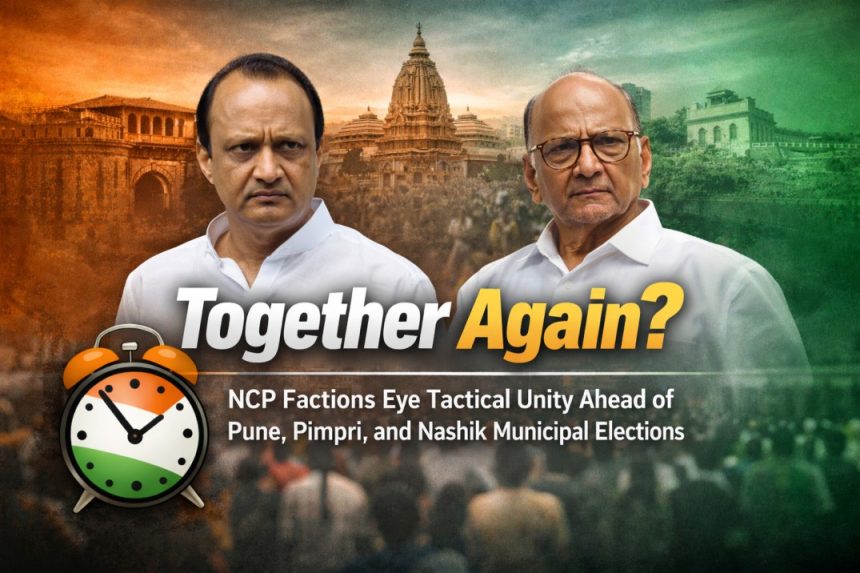
Mumbai: Speculation around the two Nationalist Congress Party factions coming together has intensified as Maharashtra heads toward crucial municipal elections. While there is no formal announcement, political circles are abuzz with discussions suggesting that both the Sharad Pawar–led NCP (SP) and the Ajit Pawar–led NCP are exploring limited, tactical coordination in select civic bodies to prevent vote division and retain relevance in urban politics.
A Party Shaped by Local Power
Since its formation, the NCP built its political strength through control of local bodies, cooperative institutions, and municipal corporations. Civic elections served as the party’s organisational backbone, producing leadership that later rose to prominence at the state level. This legacy makes municipal polls especially significant for both factions, as local governance has historically been central to NCP’s identity.
The 2023 Split and Its Political Aftershocks
The split in 2023 fundamentally altered the party’s structure and voter base. What was once a single, cohesive organisation fractured into two competing entities, each claiming continuity and legitimacy. The division weakened grassroots unity and created parallel power centres, particularly in cities where personal influence often outweighs party ideology.
Post-Split Electoral Reality
Elections held after the split revealed a complex picture. One faction demonstrated stronger organisational control and access to resources, while the other retained emotional loyalty among long-time supporters. Municipal elections, driven by ward-level networks rather than high-voltage campaigning, have emerged as the true test of which faction commands ground-level strength.
Civic Poll Outcomes Shape NCP’s Strategic Thinking
Recent local body election results have significantly influenced the Nationalist Congress Party’s internal calculations. In Pune district, the Ajit Pawar–led NCP secured 10 out of 17 municipal chairman posts, reinforcing its organisational grip across municipal councils and nagar panchayats. At the state level, NCP candidates collectively won hundreds of seats and several president posts in municipal councils and nagar panchayats, underlining the party’s continued relevance in grassroots politics despite intense competition from larger parties. In Nashik, the results reflected a mixed picture—while Shiv Sena emerged ahead in chairman posts, the NCP still carved out a notable presence with three chairman victories, indicating region-specific strengths and weaknesses. Additionally, victories by independent NCP-backed candidates in smaller urban bodies such as Daund and Fursungi highlighted the party’s enduring ward-level influence and the importance of local leadership networks.
Municipal Poll Calculus and Tactical Thinking
The renewed talk of coming together is rooted less in reconciliation and more in electoral arithmetic. Local leaders across cities are weighing the cost of three-cornered contests and the risk of handing advantage to rival parties. As a result, discussions on seat adjustments or informal understandings are taking place quietly, without any statewide alliance blueprint.
Ripple Effects on Opposition Unity
The evolving NCP dynamics have also unsettled traditional opposition equations. Uncertainty over alliances has triggered leadership churn and weakened coordination, especially in urban centres. This fragmentation has reshaped the political contest in municipal corporations, where unity often decides control.
Battle for Relevance and Political Authority
For one faction, municipal victories are key to asserting organisational dominance and long-term political legitimacy. For the other, even limited success is crucial to demonstrate survival, relevance, and bargaining power. These elections will influence not only city governance but also future alliance negotiations ahead of state elections.
A Defining Phase for NCP’s Future
Whether the NCP factions ultimately come together, compete aggressively, or adopt a mixed approach will define the next phase of Maharashtra’s politics. What is clear is that municipal elections are no longer routine local contests but a decisive battleground for the party’s future direction and legacy.