Union Budget 2026: A Strategic Blueprint for Growth and Welfare
By | Arvind Jadhav
New Delhi: The Union Budget 2026, presented today by Finance Minister Nirmala Sitharaman, outlines a comprehensive strategy aimed at economic recovery, sustainable growth, and welfare expansion. With a focus on strengthening India’s fiscal health, boosting infrastructure development, and fostering a green economy, the Budget attempts to balance the immediate economic challenges posed by the pandemic with long-term financial goals. At its core, this Budget seeks to create a resilient economy, create employment, and ensure inclusive development across all sectors.
Prime Highlights of the Union Budget 2026
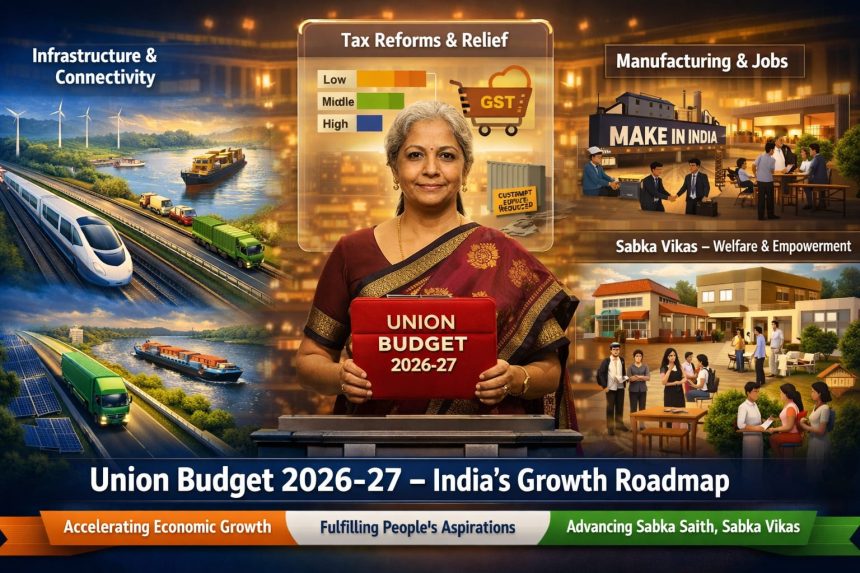
One of the key features of this year’s Budget is the focus on infrastructure. A massive allocation of ₹10 lakh crore has been made to support critical infrastructure projects, particularly in roads, railways, ports, and renewable energy. This marks the government’s commitment to promoting job creation and sustainable development, with projects expected to generate thousands of employment opportunities, particularly in rural areas. Alongside this, there are tax reforms aimed at providing relief to the middle class, including a 5% reduction in income tax rates, which has been hailed as a positive move by tax experts. Simplification of corporate taxes, coupled with new tax incentives for startups, is expected to encourage entrepreneurship and boost investment.
Political Reactions to the Union Budget 2026
The Union Budget has stirred significant political debate, with reactions ranging from praise to criticism. Ruling party leaders have expressed strong support for the Budget, emphasizing its focus on growth, welfare, and long-term economic resilience. Prime Minister Narendra Modi congratulated the Finance Minister for delivering a forward-looking Budget, stating, “This is a Budget designed to transform India into a $5 trillion economy. By investing in growth and infrastructure, we are not only securing the present but also creating a future that will be prosperous for all.”
On the other hand, opposition leaders have voiced strong concerns, particularly regarding the Budget’s impact on rural and farming communities. Congress President Mallikarjun Kharge criticized the Budget, calling it “a paper tiger,” accusing the government of overlooking the struggles faced by farmers and the working-class. “The middle class and farmers have been left out in the cold,” stated Kharge. Moreover, regional parties have expressed dissatisfaction with the lack of specific provisions for their states, particularly in the areas of rural infrastructure and regional connectivity.
Economic Impact of the Union Budget 2026
The Union Budget 2026 is expected to have a substantial impact on key sectors of the economy. With an emphasis on infrastructure development, healthcare, and education, the Budget seeks to address long-standing challenges while positioning India for future growth. The renewable energy initiatives are particularly noteworthy, with ₹1 lakh crore allocated for the development of solar energy and the electric vehicle infrastructure, aligning India with global sustainability goals. These investments are expected to create a more energy-efficient economy and contribute to the reduction of India’s carbon footprint.
The increased funding for healthcare and education is seen as a direct response to the demands for improved public services in the wake of the pandemic. The healthcare sector, in particular, will benefit from enhanced medical infrastructure and a focus on expanding telemedicine services, which are expected to make healthcare more accessible to rural areas. Additionally, the education sector will see a boost, with funding earmarked for online learning platforms and skill development programs, aiming to equip the workforce with the skills needed to thrive in an increasingly digital economy.
Welfare Measures and Focus on Rural Development
The Union Budget 2026 has placed significant emphasis on welfare schemes aimed at uplifting rural communities. The government has introduced PM Kisan Samman Nidhi Yojana, a direct financial aid initiative targeted at small farmers and entrepreneurs in rural areas. This move is expected to provide immediate relief to those who have struggled due to the economic fallout from the pandemic. Additionally, the allocation for rural healthcare will help expand access to affordable medical services in underserved regions. This is a critical step in improving the living standards of rural populations and ensuring they are not left behind in the nation’s growth trajectory.
Expert Opinions on the Budget
Economists and financial experts have offered mixed reactions to the Union Budget. Dr. Arvind Virmani, a prominent economist and former Chief Economic Adviser to the Government of India, praised the Budget’s focus on infrastructure investment, calling it “a well-calculated move to boost employment and revive the economy.” The emphasis on digital transformation and financial inclusion was also applauded as forward-thinking. “By prioritizing the digital economy and green energy, the government is laying the groundwork for a sustainable future,” Dr. Virmani noted.
However, there are concerns about the fiscal deficit. The government aims to reduce the fiscal deficit to 4.5% of GDP by 2028, but some experts warn that this may lead to higher inflation in the short term. According to Dr. Rathin Roy, Director of the National Institute of Public Finance and Policy, “While the Budget is growth-oriented, the reliance on borrowing may create challenges in managing the country’s debt burden in the coming years.”
A Forward-Looking Budget Amidst Political Divide
The Union Budget 2026 marks a significant step in India’s journey toward becoming a global economic powerhouse. With bold measures aimed at fostering growth, creating jobs, and strengthening welfare systems, the Budget attempts to address the diverse needs of the economy. However, the political divide over the Budget’s efficacy cannot be ignored, with significant concerns raised by opposition parties regarding its implementation and the inclusivity of its provisions.
As the Budget undergoes parliamentary scrutiny, its impact on India’s political and economic landscape will unfold in the coming months. For now, it represents a strategic attempt to balance immediate recovery with long-term sustainability, setting the stage for India’s economic future