


Union Budget 2026 Allocates Funds for High-Speed Rail Projects
By | Arvind Jadhav
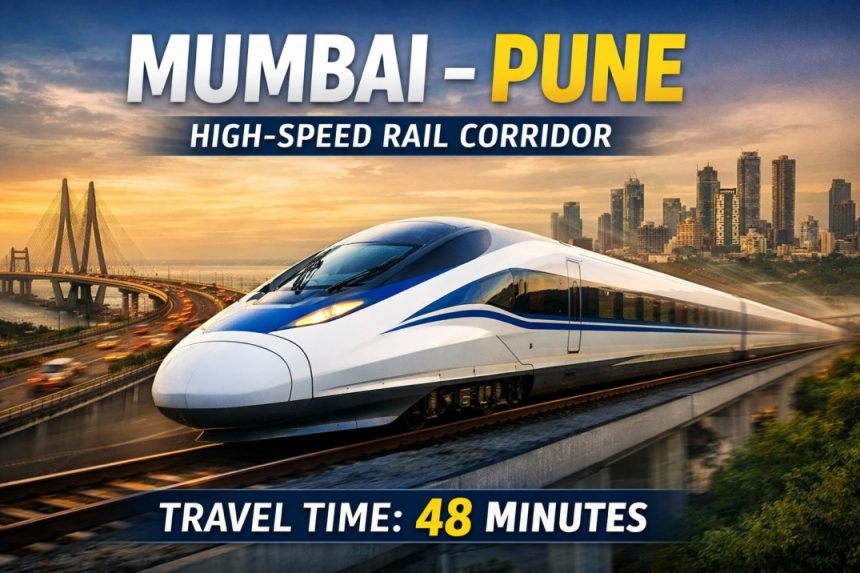
Mumbai: The Union Budget 2026 has unveiled a transformative vision for India’s transportation sector, placing significant emphasis on high-speed rail corridors. Among the most highly anticipated projects is the Mumbai-Pune High-Speed Rail Corridor, aimed at drastically reducing the travel time between Mumbai and Pune. Once completed, this bullet train will cut down the current travel time of over 3 hours to just 48 minutes, marking a significant milestone in India’s high-speed rail ambitions.
A Game-Changing High-Speed Rail Project
The Mumbai-Pune High-Speed Rail Corridor will cover a 170-kilometer stretch and is expected to travel at speeds of up to 300 km/h. The new train will integrate with the existing National High-Speed Rail Corporation of India (NHSRCL) network, which is a crucial part of the government’s broader vision to modernize India’s railway infrastructure and connect key cities through high-speed rail.
Key Benefits: Enhanced Connectivity and Faster Travel
The Mumbai-Pune corridor promises to be a game-changer for commuters. With travel time slashed to just 48 minutes, business and leisure travelers will enjoy a faster and more efficient alternative to road travel. The improved connectivity will foster stronger economic ties between Mumbai, the financial capital, and Pune, an IT and educational hub. Additionally, the bullet train will reduce traffic congestion, especially on the heavily trafficked Mumbai-Pune Expressway, and provide an environmentally friendly alternative to cars and buses.
A Major Boost to Local Economies
Beyond the personal benefits of faster travel, the Mumbai-Pune high-speed rail corridor is expected to give a significant boost to the local economies. Easier access to both cities will promote business operations and investment, as well as enhance tourism. Commuters can travel for work or leisure in a fraction of the time, stimulating growth and development in various sectors. The project will also lead to job creation in construction, operations, and maintenance.
Expanding India’s High-Speed Rail Network
The Mumbai-Pune High-Speed Rail Corridor is part of a broader effort to modernize India’s railway infrastructure. The government plans to build more than 8,000 kilometers of high-speed rail by 2030, linking major urban centers and enhancing intercity connectivity. This development will place India among the world leaders in high-speed rail technology.
Notable High-Speed Rail Corridors in Development
India is advancing several key high-speed rail corridors that will revolutionize travel across the country. Some of the major corridors include:
Mumbai-Ahmedabad Corridor: The first high-speed rail line to be developed under the India-Japan collaboration, this corridor will cut travel time between Mumbai and Ahmedabad from 7 hours to 2 hours.
Delhi-Varanasi Corridor: This corridor will connect Delhi with Varanasi, slashing the travel time from 12 hours to 6 hours, and improving accessibility to one of India’s most culturally significant cities.
Delhi-Agra Corridor: Designed to boost tourism, the Delhi-Agra corridor will reduce travel time between Delhi and Agra from 3-4 hours to 1 hour, making it easier for visitors to explore the Taj Mahal and other historical landmarks.
Bengaluru-Hyderabad Corridor: Scheduled to reduce the travel time between Bengaluru and Hyderabad to just 2 hours, this corridor will further enhance connectivity in the southern region of India, benefiting both business and tourism sectors.
Technological Innovations: The Future of High-Speed Rail in India
India’s high-speed rail projects are set to incorporate the latest technologies to ensure the highest levels of safety, speed, and comfort. The trains will feature advanced signaling systems, automated controls, and a host of modern amenities, including Wi-Fi and air-conditioned compartments. The system will also be powered by green energy, helping to reduce the country’s reliance on fossil fuels and supporting environmental sustainability goals.
Economic Impacts: Job Creation and Investment Opportunities
In addition to the speed and comfort offered by high-speed rail, these projects are expected to have a substantial economic impact. The construction of high-speed rail lines will create thousands of jobs in engineering, infrastructure, and technology. Furthermore, enhanced connectivity will drive trade, investment, and tourism, benefiting various industries and regions. The development of rail stations and nearby infrastructure will likely spur real estate growth, creating new hubs of economic activity.
The Road Map: India’s Vision for a Bullet Train Revolution
The Mumbai-Pune High-Speed Rail Corridor is just one component of India’s larger vision for transforming its transportation network. With more than 8,000 kilometers of high-speed rail under development, India is poised to become a global leader in rail technology and infrastructure. By providing a modern, sustainable, and efficient means of travel, these high-speed rail projects will reshape the way people move across the country, benefiting both the economy and the environment.