

Rising living costs, education concerns and pressure on public services fuel demonstrations as authorities prepare tougher security measures
🔴 By | PR Network
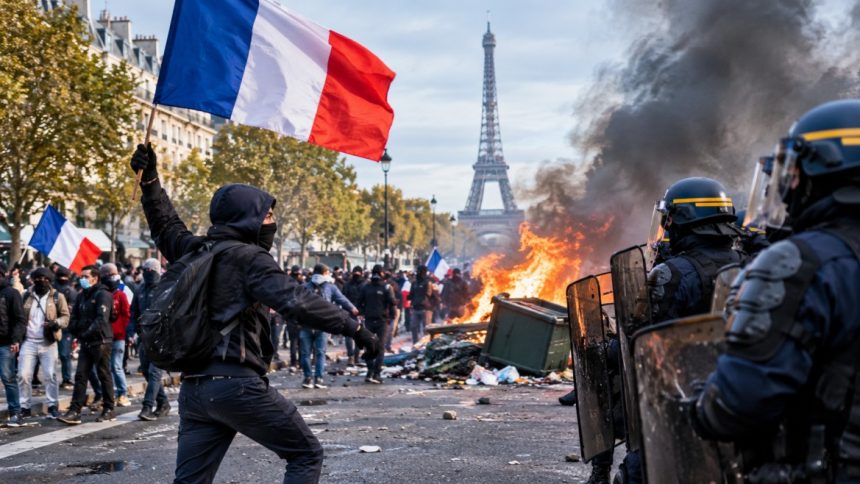
Paris : France is facing renewed political and social tensions as public dissatisfaction over living costs, education and public services puts pressure on President Emmanuel Macron’s government. Demonstrations on October 17, 2026, reportedly escalated into incidents of looting, property damage and clashes with police in several cities. The developments have raised concerns about public order and the government’s ability to address growing public frustration. With further demonstrations planned, the coming days could prove critical for France’s political leadership.
🟡 Government Takes a Tougher Position on Security
President Emmanuel Macron has condemned violence and damage to public property while maintaining that peaceful demonstrations are a legitimate part of democracy. The government’s position is that citizens have the right to protest, but looting, attacks on businesses and violence against police cannot be tolerated.
Prime Minister Sébastien Lecornu has indicated that stronger security arrangements will be introduced for upcoming demonstrations. Authorities are preparing additional deployments to prevent a repeat of the unrest and protect public infrastructure and commercial establishments.
The government faces a difficult balancing act: maintaining law and order without further aggravating citizens who are already dissatisfied with economic conditions and public policy. While a stronger security response may help prevent violence, it cannot by itself resolve the underlying grievances driving the demonstrations.
🟡 Protesters Demand Action on Living Costs and Public Services
The protesters’ concerns extend beyond public order. Rising household expenses, pressure on family budgets, school overcrowding, teacher shortages and concerns over public-service funding have contributed to dissatisfaction among sections of French society.
Student groups, trade unions and activists associated with the Yellow Vest movement have signalled continued mobilisation. Protesters are demanding concrete measures to address economic hardship, improve educational facilities and protect essential public services.
Trade unions argue that stronger policing will not solve the problems facing ordinary citizens. They want the government to engage in meaningful negotiations and deliver practical relief rather than relying primarily on security measures.
However, the movement does not represent a single political position. Peaceful demonstrators, organised labour groups, students and individuals involved in violent incidents have different motivations and should not be treated as one unified group.
🟡 Arrests and Security Measures Put Authorities Under Pressure
The reported violence has increased pressure on French law-enforcement agencies. According to reports published on October 21, approximately 2,500 people had been detained in connection with the unrest, while more than 900 cases had reportedly been referred for prosecution.
Authorities are expected to maintain a heightened security presence during further demonstrations. The challenge will be to prevent violence while ensuring that peaceful protesters can exercise their democratic rights.
The handling of the protests could also become a political issue, particularly if questions emerge over police conduct, the proportionality of security measures or the government’s preparedness.
🟡 Immigration Debate Adds a Political Dimension
The unrest has also become part of a wider political debate about immigration, national identity and social integration in France.
Macron has rejected attempts by foreign political figures to portray immigration as the principal explanation for the unrest. The broader situation involves multiple factors, including economic pressures, dissatisfaction with public services and disagreements over government policy.
There is no sufficient basis to conclude that the demonstrations represent a nationwide uprising against Muslims or that any religious community is collectively responsible for the unrest. Treating immigration or religion as the sole explanation would overlook the economic and social issues at the centre of the protests.
The debate nevertheless illustrates how domestic unrest can become a focal point for competing political narratives, both within France and internationally.
🟡 Macron Faces a Critical Political Test
France’s immediate challenge is to restore public confidence while preventing further violence. If the government responds to protesters with security measures alone, dissatisfaction could persist and demonstrations could become more difficult to contain.
Conversely, meaningful negotiations with trade unions, students and other representatives could create an opportunity to reduce tensions. Measures addressing household costs, education and public services would be important in demonstrating that the government is listening to public concerns.
The planned demonstrations on October 24 and a proposed nationwide strike on November 5 are important dates to watch, although the scale and outcome of these events remain uncertain.
The political consequences could extend beyond the immediate crisis. As France approaches its 2027 presidential election, the government’s handling of public anger may influence voter confidence, strengthen opposition parties and intensify debates over economic policy, security and immigration.