


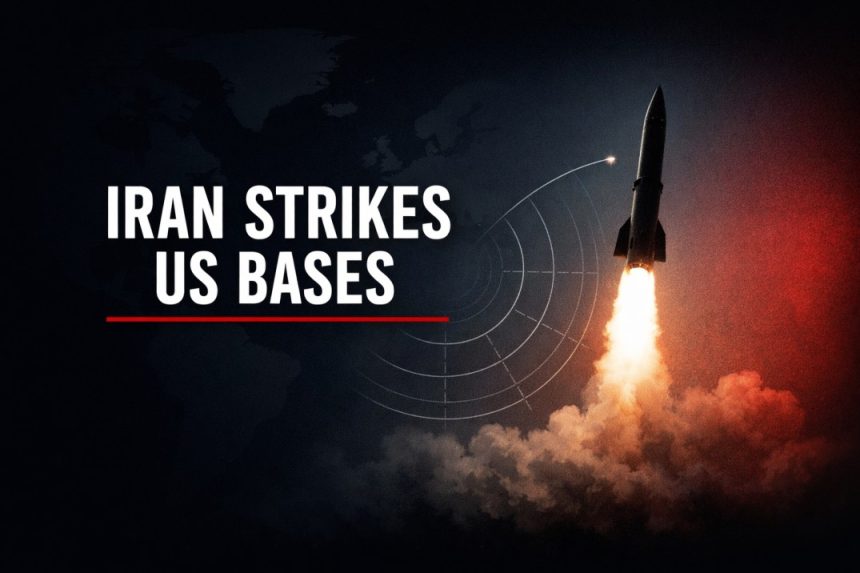
Iran Targets U.S. Bases and Maritime Zones With Missile Barrage
By | Arvind Jadhav
Middle East tensions have escalated sharply after Iran launched ballistic missiles and drones toward American military bases and strategic maritime areas in the Gulf. Iranian officials described the operation as retaliation for recent military actions carried out by the United States and its regional allies.
Air-defence systems across the region were activated as multiple projectiles entered Gulf airspace. Several missiles were intercepted before impact, while others reportedly landed in open waters, highlighting the growing threat to military and commercial shipping routes.
Strike Near U.S. Naval Command Hub in Bahrain
One of the most sensitive incidents was reported near the U.S. naval command area in Bahrain, where a missile landed close to facilities associated with the U.S. Navy Fifth Fleet. While operational capabilities were not significantly disrupted, the strike demonstrated Iran’s willingness to target key American naval infrastructure in the Gulf.
Security agencies heightened alert levels across nearby bases and ports following the incident.
Multiple Waves of Missiles and Drones Reported
Iran’s military command, including elements of the Islamic Revolutionary Guard Corps, claimed responsibility for several waves of missile and drone launches. The strikes were aimed at airbases, radar systems and logistics hubs used by American forces and their partners.
Defence systems across Qatar and neighbouring territories were placed on high readiness, with interceptions reported in several locations. Though large-scale destruction was avoided in many areas, scattered impacts caused localized damage and panic.
Part of a Wider Escalation Cycle
The missile launches come amid a broader confrontation following earlier air and naval operations targeting Iranian installations. Tehran has warned that American bases and naval assets throughout the region remain within its strike range, suggesting further retaliation could follow.
Security analysts warn that continued attacks could threaten energy shipments and global trade routes, particularly around the Strait of Hormuz, one of the world’s most critical oil transit corridors.
Global Concern Over Possible Wider War
World leaders have urged restraint as fears grow that continued exchanges could spiral into a full-scale regional conflict involving multiple nations and naval forces. Diplomats say the coming days will be crucial in determining whether the crisis moves toward de-escalation or deeper confrontation.
The situation remains fluid, with military forces across the Gulf region on heightened alert.