


🔴 By | Arvind Jadhav
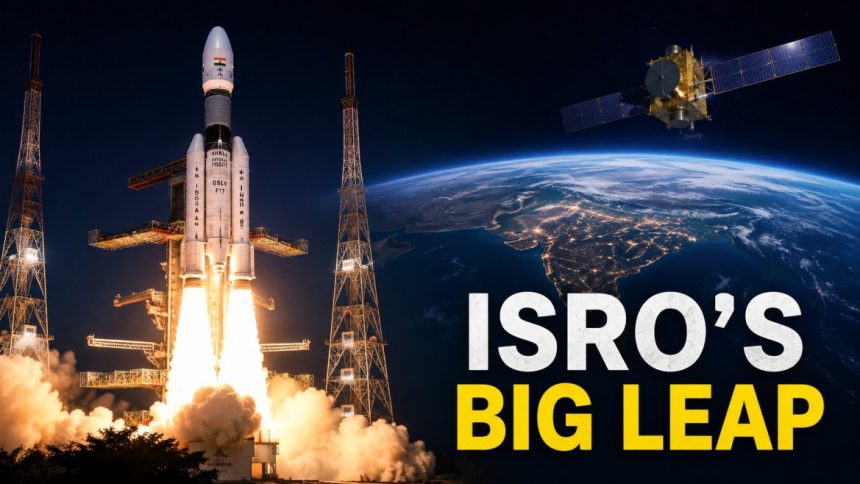
Sriharikota | India has once again demonstrated its growing space capabilities as the Indian Space Research Organisation (ISRO) successfully launched the GSLV-F17 rocket carrying EOS-05, an advanced Earth-observation satellite, from the Satish Dhawan Space Centre in Sriharikota.
The launch took place at 2:55 AM on Friday, marking an important milestone for India’s Earth-observation programme. ISRO confirmed that the mission successfully placed EOS-05 into its designated initial orbit.
🟡 A Major Mission for India’s Space Programme
The GSLV-F17/EOS-05 mission is significant because the satellite is designed to operate from a geosynchronous orbit, allowing it to maintain a continuous view of a large region of the Earth.
Unlike conventional satellites that repeatedly pass over the same locations, a geosynchronous satellite can provide persistent observation of a particular broad area. This capability can be particularly valuable for monitoring rapidly changing conditions on Earth.
🟡 EOS-05: India’s New Eye in the Sky
EOS-05 is an advanced Earth-observation spacecraft weighing approximately 2,367 kg. The satellite is expected to strengthen India’s ability to collect high-quality information about the Earth and its changing environment.
The data generated by such a satellite can have applications across several sectors, including agriculture, water resources, forestry, environmental monitoring, urban development and disaster management.
🟡 Help During Natural Disasters
One of the most important applications of Earth-observation satellites is disaster monitoring.
Satellite-based observations can help authorities assess situations during floods, cyclones, landslides and other natural disasters. Rapid access to large-area imagery can assist in identifying affected regions and supporting relief and response planning.
The ability of EOS-05 to observe a large region continuously could further strengthen these capabilities.
🟡 Benefits for Agriculture and Water Resources
India’s agricultural sector is another major area where satellite imagery can play an important role.
Earth-observation data can assist in monitoring crop conditions, land-use changes, water bodies and environmental patterns. Such information can support planning and decision-making by government agencies and other institutions.
The satellite’s observations could therefore have applications extending well beyond the space sector.
🟡 GSLV-F17 Shows Its Strength
The mission was carried out using the Geosynchronous Satellite Launch Vehicle GSLV-F17, one of India’s important heavy-lift launch vehicles.
The GSLV uses a combination of solid, liquid and cryogenic propulsion technologies and is designed to place heavier spacecraft into higher orbits.
The successful mission once again highlights India’s growing capability to develop and operate sophisticated launch systems domestically.
🟡 From Sriharikota to Geosynchronous Orbit
Following liftoff from Sriharikota, the GSLV-F17 completed its flight sequence and deployed EOS-05 into its planned Sub-Geosynchronous Transfer Orbit.
The spacecraft will subsequently undergo orbital manoeuvres to reach its operational geosynchronous position.
This complex process demonstrates the precision required in launching and positioning large satellites in space.
🟡 A Confidence Boost for ISRO
The successful GSLV-F17 mission is also an important confidence boost for ISRO as India continues to expand its space programme.
With increasing emphasis on Earth observation, communications, navigation, human spaceflight and deep-space exploration, reliable launch capabilities have become increasingly important for India’s long-term space ambitions.
🟡 India’s Space Ambitions Continue to Grow
India is rapidly expanding its presence in the global space sector. Missions such as GSLV-F17/EOS-05 add to the country’s growing fleet of satellites and strengthen its ability to independently develop, launch and operate sophisticated spacecraft.
The latest mission also underlines the importance of space-based technology in everyday life—from agriculture and weather monitoring to disaster management and environmental protection.
🟡 Another Milestone in India’s Space Journey
The successful launch of EOS-05 is more than another rocket launch for India. It represents another step towards building a stronger and more capable national Earth-observation infrastructure.
As EOS-05 begins its journey towards its operational orbit, India’s ability to monitor its territory and the wider region from space is set to become even more powerful.
With GSLV-F17 successfully completing its mission, ISRO has once again shown that India’s space ambitions are moving steadily from the launch pad towards a new generation of advanced space capabilities.