


452-km Road Concretisation Plan Announced; Pending Projects, Public Protests, Political Allegations, Road Accidents and High Court Directions Raise Questions Over Accountability
🔴 By| Arvind Jadhav
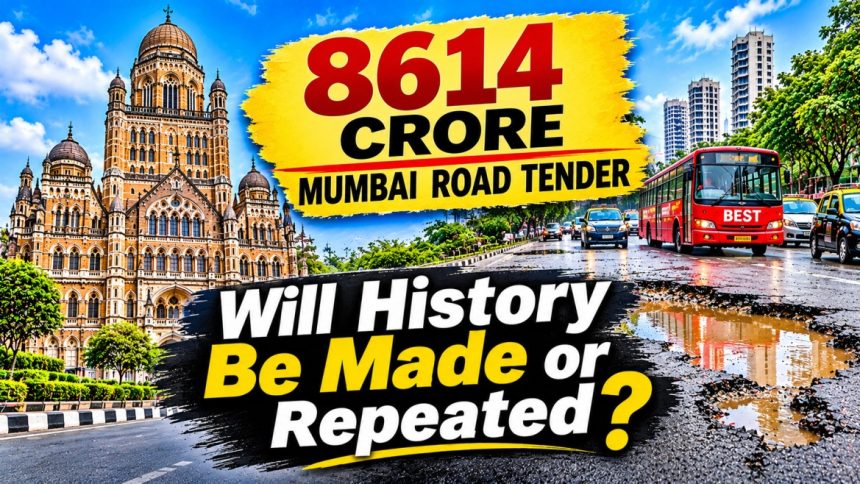
Mumbai : City’s battle against potholes and deteriorating roads is set to enter another major phase, with the Brihanmumbai Municipal Corporation (BMC) floating a massive tender worth ₹8,614 crore for road concretisation across the city. The proposed third phase will cover approximately 452 kilometres of roads across Mumbai’s island city, eastern suburbs and western suburbs. However, the announcement has also brought an important question back into focus: will the new project finally address the problems that have continued despite thousands of crores already being spent on Mumbai’s roads?
For ordinary Mumbaikars, the issue goes beyond infrastructure development. Incomplete road works, repeated excavation, traffic congestion, pothole complaints and safety concerns have become recurring problems. With the previous concretisation programme facing delays and criticism, citizens are now looking for answers on how the new investment will be monitored and whether lessons from earlier projects will be incorporated.
🟡 8,614 Crore Tender to Cover 452 Kilometres of Roads
According to reports published on November 6, 2026, the BMC has floated a tender worth ₹8,614 crore for the third phase of its ambitious road concretisation programme.
The project includes full-width concretisation of 1,261 roads covering approximately 313 kilometres. In addition, side strips of another 176 roads, measuring around 139 kilometres, will also be concretised. This brings the total coverage to 1,437 road stretches and approximately 452 kilometres.
The project will cover the island city as well as the eastern and western suburbs. The tendering process is expected to be completed by December 2026, with construction likely to begin in January 2027.
The civic body’s objective is to improve road durability, reduce potholes and provide smoother commuting conditions. However, the performance of previous contractors and the status of incomplete projects have raised questions about the execution of this new phase.
🟡 17,700 Crore Earlier Project: Why Were 275 Roads Still Pending?
The BMC had previously undertaken a massive road concretisation programme involving contracts worth approximately ₹17,700 crore.
However, a report published by The Indian Express on September 28, 2026, highlighted that work on 275 roads had not yet commenced. The estimated value of these pending works was around ₹380 crore.
Following delays, the civic administration reportedly proposed withdrawing certain works awarded to NCC Limited and Eagle Infra India.
The contractors, however, presented their own explanations. Eagle Infra reportedly stated that it had completed 154 out of 182 assigned roads. NCC, meanwhile, cited restrictions on traffic management and delays caused by the monsoon as reasons affecting progress.
The matter raises several questions. What action was eventually taken against the contractors? Were the pending projects reassigned? What is the current status of these roads?
Before committing another ₹8,614 crore, citizens deserve a transparent account of the previous project’s performance.
🟡 More Than 10,000 Pothole Complaints and Unusual Public Protests
Potholes have remained a major civic concern in Mumbai, prompting residents and citizen organisations to repeatedly raise their voices against poor road conditions.
According to a Free Press Journal report, the BMC received 10,106 pothole complaints between June 10 and September 10, 2026.
The issue also triggered an unusual protest by the Watchdog Foundation near Sahar Road. The organisation announced a symbolic demonstration involving cockroaches in potholes to draw attention to the condition of roads and alleged civic neglect.
Earlier, by August 20, 2026, the BMC had reportedly received 8,032 pothole complaints and claimed to have resolved 7,829 of them.
Several eastern suburban areas, including Bhandup, Govandi, Deonar, Mankhurd, Chembur and Tilak Nagar, also featured among areas facing pothole complaints.
However, an important question remains: does marking a complaint as resolved mean that the road has been permanently repaired? Temporary patchwork and durable road restoration are two different things. Citizens need roads that remain safe after repairs, not merely complaints marked as closed in official records.
🟡 Political Opposition Questions the Need for Another Concretisation Phase
Mumbai’s road concretisation programme has also become a subject of political criticism.
On May 14, 2026, Shiv Sena (UBT) MLA Varun Sardesai reportedly wrote to the BMC Commissioner, seeking reconsideration of the proposed third phase of road concretisation.
He raised concerns about incomplete earlier works, traffic congestion, inconvenience to residents and the financial burden of undertaking another large-scale phase while previous projects were still pending.
Sardesai also raised questions about the quality of certain completed roads and allegations of irregularities in earlier contracts. These were political allegations and should be distinguished from independently established findings.
On July 2, 2026, Aaditya Thackeray also criticised the condition of Mumbai’s roads and raised concerns about contractors and the quality of road works.
The political criticism has brought the issue of accountability into focus. If roads are being concretised at enormous public expense, why do citizens continue to complain about potholes, damaged surfaces and repeated excavation?
The BMC’s response and the actual condition of completed roads will be important in assessing these competing claims.
🟡 Road Accidents: Official Statistics Highlight the Safety Challenge
Poor road conditions are not merely a matter of inconvenience. They can pose serious risks, particularly for two-wheeler riders, cyclists and pedestrians.
According to the Mumbai Traffic Police’s official Mumbai Road Safety Annual Report 2023, the city recorded 351 fatal road accidents, resulting in 374 deaths during the year. Another 2,125 accidents resulted in 2,611 injuries.
The report also indicated that two-wheeler and three-wheeler occupants accounted for approximately 48 per cent of road accident fatalities, while pedestrians accounted for around 40 per cent.
These figures underline the wider road safety challenge facing Mumbai. However, they represent all road accidents and do not establish that potholes caused these deaths.
The number of accidents, injuries and fatalities specifically attributable to potholes needs to be established through separate official police records. Publishing such information would help identify dangerous road stretches and improve accountability.
🟡 Bombay High Court’s Directions: Compensation and Accountability
The Bombay High Court has also taken a serious view of deaths and injuries caused by potholes and uncovered manholes.
In its October 13, 2025 order, the court addressed the responsibility of civic authorities for maintaining safe roads and laid down compensation provisions for victims.
The directions included compensation of ₹6 lakh to the legal heirs of a person who dies due to a pothole or uncovered manhole. Compensation provisions were also specified for injured victims, depending on the severity of their injuries.
The court directed the formation of committees involving the concerned civic authority and the District Legal Services Authority to examine compensation claims.
It also emphasised the importance of constructing and maintaining roads that do not require repeated repairs for at least five to ten years. Directions regarding timely pothole repairs, accountability of contractors and engineers, and recovery of compensation from those found responsible were also part of the order.
These directions make it clear that road maintenance is not merely an administrative responsibility. It also carries legal consequences when negligence results in loss of life or serious injuries.
🟡 Will the New Project Follow the High Court’s Directions?
The new ₹8,614 crore project raises several questions in light of the High Court’s directions.
Will the BMC introduce independent quality inspections for every completed road? Will contractors be held accountable if newly concretised roads develop defects? Will the civic administration publish road-wise construction costs, contractor details and inspection reports?
Another major concern is repeated excavation by different utility agencies. Water pipelines, drainage networks, electricity cables and telecommunications infrastructure often require road cutting. Unless these activities are coordinated before concretisation, newly constructed roads may once again be damaged.
A long-term road development programme must therefore include coordination between all utility agencies, strict construction standards and effective monitoring of contractors.
🟡 Mumbaikars Want Accountability, Not Just Another Mega Tender
The ₹8,614 crore tender represents a significant financial commitment towards Mumbai’s infrastructure. However, the success of this project cannot be measured simply by the number of kilometres concretised.
The BMC must also explain the status of the earlier ₹17,700 crore programme, the pending 275 roads, action against delayed contractors and the measures being introduced to prevent repeated road damage.
Citizens also deserve access to transparent information about project costs, construction timelines, quality inspections and maintenance responsibilities.
For Mumbaikars, the real expectation is simple: roads that remain safe during the monsoon, do not develop potholes repeatedly and provide a reliable commuting experience throughout the year.
The central question is no longer just how much money the BMC plans to spend. It is whether the new ₹8,614 crore project will finally deliver the durable, safe and pothole-free roads that Mumbai has been promised for years.
Will the lessons from past delays, public protests, political criticism, road safety concerns and the Bombay High Court’s directions shape this new phase? Mumbai’s citizens will be watching closely.