


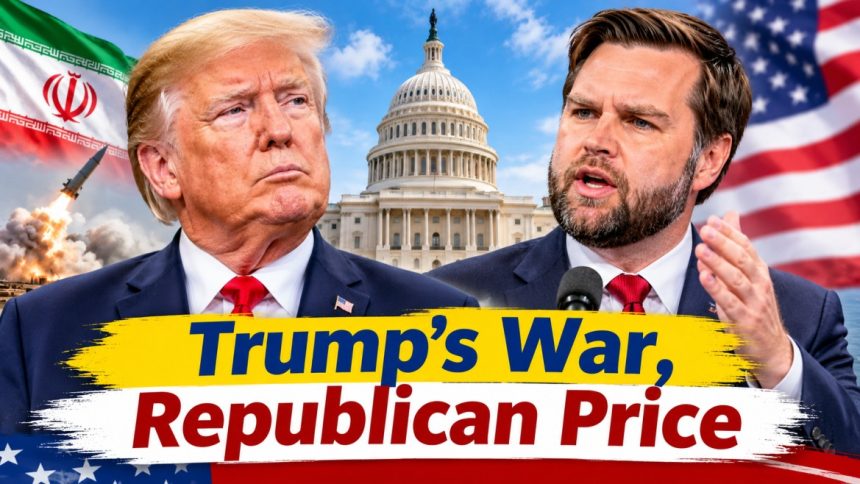
Democrats take control of Congress as Vance questions the cost of the Iran conflict, while inflation, tariffs and voter dissatisfaction expose deeper problems for Trump’s administration.
🔴 By | PR Network
The 2026 US midterm elections have delivered a major political setback to President Donald Trump and his Republican Party. Democrats have taken control of both the House of Representatives and the Senate, creating a serious challenge for Trump’s remaining two years in office. However, the most striking development following the election has come from Vice President JD Vance, who has openly blamed the ongoing Iran war for the Republican defeat. His remarks have triggered a wider debate about whether Trump’s military intervention in the Middle East has become a political liability at home, and whether the real problem goes much deeper than foreign policy.
In a lengthy post on social media platform X on November 4, Vance made his position clear. “The reason we lost is the war,” he wrote, arguing that many Americans who supported Trump and Vance in the 2024 presidential election switched their support to Democratic candidates in 2026. He also questioned whether the political cost of the conflict, including losing control of the Senate, was worth paying. His statement represents one of the strongest public criticisms of the administration’s Iran policy from within its own leadership.
🟡 JD Vance’s Four-Point Explanation for Republican Defeat
Vance said he had spoken with political pollsters who had examined the reasons behind former Trump supporters turning against Republican candidates. According to his account, these voters identified four major concerns: ending the Iran war, focusing on the cost of living and inflation, putting America First, and changing the United States’ relationship with Israel.
This is politically significant because the concerns extend beyond military intervention. They reflect a broader demand among some Republican voters for the administration to concentrate on domestic economic priorities rather than prolonged overseas conflicts.
Vance also referred to earlier advice from a conservative commentator who had urged the administration to pursue a diplomatic resolution to the Iran conflict. He described that advice as sound, further highlighting his dissatisfaction with the direction of the war.
However, the pollster Vance referred to was not publicly identified in his statement. His account should therefore be understood as his explanation of voter sentiment, rather than an independently published nationwide survey.
🟡 Trump and Vance: Two Different Approaches to the Iran War
The difference between Trump and his vice-president has become one of the most interesting political developments following the election.
Trump acknowledged that the Iran war contributed to Republican losses. However, he continued to defend the military operation, arguing that preventing Iran from acquiring nuclear weapons justified the decision.
Responding to Vance’s comments on November 4, Trump described his assessment as largely true but insisted that he would make the same decision again.
“I did the right thing. I would have done it again,” Trump said in his response to the election fallout.
This reveals an important political distinction. Vance is emphasising the electoral and economic cost of the conflict, whereas Trump continues to defend its national security objectives.
According to Reuters, Vance’s public intervention has also raised questions about his political positioning ahead of the 2028 presidential election. He is widely regarded as a potential Republican presidential contender, although his future plans remain undecided.
🟡 Election Data Reveals a Bigger Problem Than the War
While Vance has identified Iran as the principal reason for the Republican defeat, independent voter survey data provides a more complicated picture.
According to the ABC News Voter Poll, 34% of voters in US House races considered the Iran war a crucial factor in their voting decision. However, 49% identified the cost of living as crucial, while 55% said government corruption was crucial to their vote.
The survey also found that approximately 59% of House voters were very concerned about healthcare costs.
These figures suggest that the Iran conflict was an important electoral issue, but it was not the only or even the most widely cited concern. Economic pressure, healthcare expenses and dissatisfaction with government conduct played a substantial role in shaping voter decisions.
This distinction is central to understanding the Republican defeat. The war may have intensified public frustration, but the broader dissatisfaction was connected to the everyday financial pressures experienced by American households.
🟡 Inflation, Fuel Prices and Trump’s Tariff Policy
The economic consequences of the Iran conflict have become particularly important because of its connection with international energy markets.
The US-Israeli military campaign against Iran began in February 2026. Although the operation significantly damaged Iran’s military infrastructure, an April ceasefire failed to produce a lasting peace agreement. Continued tensions around the Strait of Hormuz have kept international energy supplies and shipping security under pressure.
The Strait of Hormuz is one of the world’s most important oil transportation routes. Any disruption in the passage can influence global oil prices, shipping costs and energy security.
For American households, the consequences have been visible through rising petrol prices and wider economic uncertainty.
However, the Iran conflict is only one part of the economic picture. Trump’s tariff policy has also attracted criticism because import duties can increase the costs of goods, components and raw materials. ABC News reported that Trump’s tariffs had been costing the typical American household almost $1,000 annually.
The combination of fuel-related expenses, import costs and inflation has created a difficult environment for consumers. For voters concerned about household budgets, the administration’s economic promises have become an important measure of its performance.
🟡 Why Democrats Benefited From Republican Voter Dissatisfaction
The Democratic Party’s victory in both chambers of Congress represents a major change in Washington’s political balance.
Democrats made significant gains in traditionally Republican territory, demonstrating that dissatisfaction with the administration was not restricted to conventional Democratic strongholds.
The results also provide Democrats with greater influence over legislation, federal spending and congressional investigations. They will have more opportunities to scrutinise Trump’s decisions, including the military operation against Iran and the economic consequences of his policies.
However, the outcome should not automatically be interpreted as complete public endorsement of the Democratic Party’s entire political programme. The election also reflected dissatisfaction with the incumbent administration.
Democratic leaders are now under pressure to demonstrate that they can address the very issues that contributed to the Republican setback, particularly inflation, healthcare costs and household affordability.
🟡 Is JD Vance Preparing for a Post-Trump Republican Leadership?
Vance’s remarks have also opened a political discussion about the future direction of the Republican Party.
By identifying the Iran war as the reason behind the defeat, the vice-president has publicly highlighted a policy disagreement with the president. His emphasis on America First, economic priorities and reconsideration of the relationship with Israel could become important themes in future Republican political debates.
His comments may also help him establish a distinct political position ahead of the 2028 presidential election. However, it would be premature to interpret his statement as a confirmed announcement of a presidential campaign.
For Trump, the situation presents a different challenge. He must defend the strategic objectives of the Iran operation while addressing concerns among voters who believe the administration has not given sufficient attention to domestic economic problems.
🟡 Global Implications: A Domestic Election With International Consequences
The outcome of the American midterm elections will be closely watched by governments across the world.
The United States plays a major role in international security, global trade and energy markets. A change in congressional control can influence debates over military spending, foreign assistance, sanctions and diplomatic engagement.
For countries dependent on imported energy, continued uncertainty around Iran and the Strait of Hormuz remains a significant concern.
The election also highlights a wider international political lesson: foreign military interventions can create domestic political consequences when their financial costs reach ordinary households.
The Trump administration now faces the challenge of balancing its national security objectives with the economic expectations of American voters.
🟡 Final Analysis: Iran War Was the Trigger, Economic Anger Was the Bigger Story
The 2026 midterm results cannot be explained by the Iran war alone. JD Vance’s statement identifies the conflict as the central reason for the Republican defeat, but independent voter data points towards a wider combination of economic dissatisfaction, healthcare costs and concerns about government corruption.
The Iran war became a powerful symbol of public frustration because its consequences were connected to fuel prices, energy uncertainty and America’s international priorities. At the same time, Trump’s tariff policies and the continuing cost-of-living crisis added to the pressure on households.
The disagreement between Trump and Vance also reveals a debate within Republican leadership about the future direction of American foreign policy.
For Trump, the challenge is to defend his military decisions while restoring confidence in his economic agenda. For Vance, the election has created an opportunity to question the administration’s priorities and establish his own position within the Republican Party.
The biggest message from the 2026 midterm elections is that America’s international military power does not automatically translate into domestic political support. When voters are struggling with everyday expenses, even a major foreign policy operation can become an electoral liability.
Iran may have triggered the Republican political crisis, but the deeper question for Trump is whether his economic promises can still win back the confidence of American voters.