

🔴 By | Gitanjali Thorat
🟡 Rising Tensions in West Asia
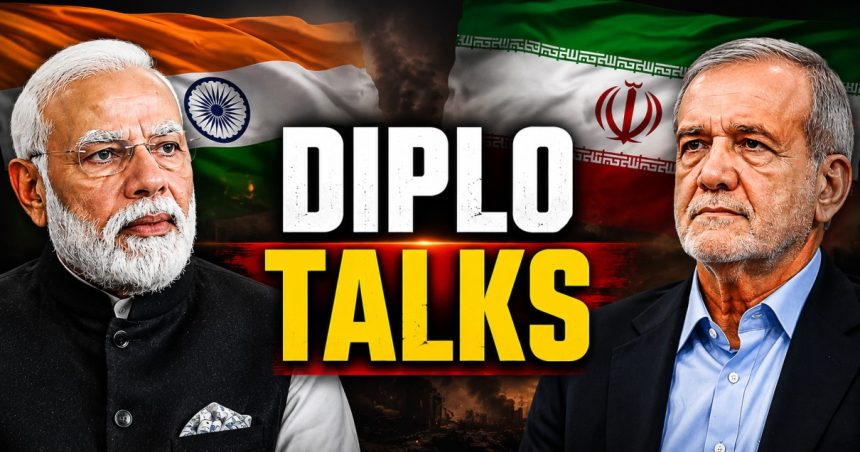
The ongoing war in West Asia has triggered global concern, with major powers getting directly or indirectly involved. Amid escalating tensions between Iran and the United States, India has stepped forward diplomatically. Prime Minister Narendra Modi recently held discussions with Iranian President Masoud Pezeshkian to assess the situation and safeguard India’s interests. This conversation comes at a time when the region is witnessing military escalation, economic uncertainty, and threats to global oil supply chains.
🟡 PM Modi–Iran President Discussion: India Calls for Peace
Prime Minister Narendra Modi spoke with Iran’s President Masoud Pezeshkian over the phone, where both leaders discussed the current war situation in West Asia. Iran briefed India about the ongoing conflict and the rising military tensions involving the United States and its allies.
During the discussion, PM Modi emphasized the importance of peace, dialogue, and diplomatic resolution. He expressed deep concern over civilian casualties and destruction of infrastructure due to the war. A key focus of the conversation was the security of the Strait of Hormuz, which is one of the most crucial oil supply routes in the world.
India clearly conveyed that free and safe navigation in this region is essential not just for India, but for global economic stability. PM Modi also stressed the need to ensure the safety of Indian citizens living in the conflict-affected areas.
🟡 Background: America-Led War Against Iran
The current West Asia war began on 28 February 2026 when the United States, along with Israel, launched targeted military strikes on Iranian installations. These attacks were reportedly aimed at Iran’s strategic and nuclear infrastructure.
Iran strongly condemned these actions and termed them as acts of aggression. In response, Iran warned of retaliation and declared its readiness for a prolonged conflict if necessary. Since then, the situation has escalated with military activity spreading across the Gulf region, including areas close to the Strait of Hormuz.
The conflict has now evolved into a broader geopolitical crisis, drawing attention from global powers and impacting international trade, oil markets, and regional security.
🟡 India–Iran Relations: Strategic and Historical Ties
India and Iran share a long-standing relationship based on energy cooperation, trade, and strategic connectivity. One of the key pillars of this partnership is energy, as Iran has historically been a major supplier of crude oil to India.
Another important aspect is the Chabahar Port project, which provides India with access to Afghanistan and Central Asia, bypassing Pakistan. This project holds significant geopolitical importance for India’s regional connectivity goals.
India follows a policy of balanced diplomacy, maintaining strong relations with Iran, the United States, Israel, and Gulf nations simultaneously. This approach, often called “multi-alignment,” allows India to protect its strategic interests without taking sides in conflicts.
Even in the current crisis, India has maintained communication with Iran while avoiding direct involvement in the conflict.
🟡 Impact of the War on India
Energy Crisis and Rising Oil Prices
India is heavily dependent on oil imports from West Asia, with a large portion of its crude oil coming from this region. The war has created uncertainty in oil supply, especially due to threats around the Strait of Hormuz.
As tensions rise, global oil prices have surged, directly affecting India’s economy. Higher fuel prices increase transportation costs, inflation, and overall economic pressure on citizens.
🟡 Threat to Shipping and Trade Routes
The Strait of Hormuz is a vital route for global oil transportation. Any disruption in this region can severely impact international trade.
There have been incidents of attacks and threats to commercial vessels in the Gulf region, including ships linked to India. Such risks increase insurance costs, delay shipments, and create instability in supply chains.
🟡 Impact on Indian Workers in Gulf Countries
Millions of Indians work in Gulf countries, contributing significantly to India’s economy through remittances. Due to the war, many workers face job losses, safety risks, and uncertainty.
In recent developments, a large number of Indian nationals have been evacuated from conflict zones. This situation could lead to a decline in remittances, affecting India’s foreign income.
🟡 Economic Pressure and Inflation
The war has led to increased fuel costs and higher prices of essential commodities. Fertilizer costs have also risen, impacting India’s agriculture sector.
To manage the situation, the Indian government has taken measures such as adjusting fuel taxes and exploring alternative oil import sources like Russia. However, prolonged conflict could slow down economic growth and increase inflation.
🟡 Diplomatic Challenges for India
India is in a delicate position as it maintains strong ties with both Iran and the United States. The war creates diplomatic pressure, making it challenging to balance relationships.
India’s strategy has been to avoid taking sides while actively promoting peace and stability. However, as the conflict intensifies, maintaining this neutral stance becomes increasingly complex.
🟡 India’s Stand: Neutral but Active
India has clearly maintained that it does not support war and prefers peaceful resolution through dialogue. The country is focused on three main priorities:
Ensuring energy security
Protecting Indian citizens abroad
Maintaining stable diplomatic relations
Prime Minister Modi has also highlighted that developing nations should not suffer due to conflicts among powerful countries, emphasizing the need for global responsibility.
🟡 A Global Crisis with Direct Impact on India
The West Asia war is no longer a regional issue—it has become a global crisis affecting economies, trade, and diplomacy. The discussion between PM Modi and Iran’s President reflects India’s proactive approach to managing the situation.
While India continues to walk a tightrope between major global powers, its focus remains on safeguarding national interests and promoting peace. The coming days will be crucial as the conflict evolves and its impact deepens on countries like India.