


🔴 By| PR Network
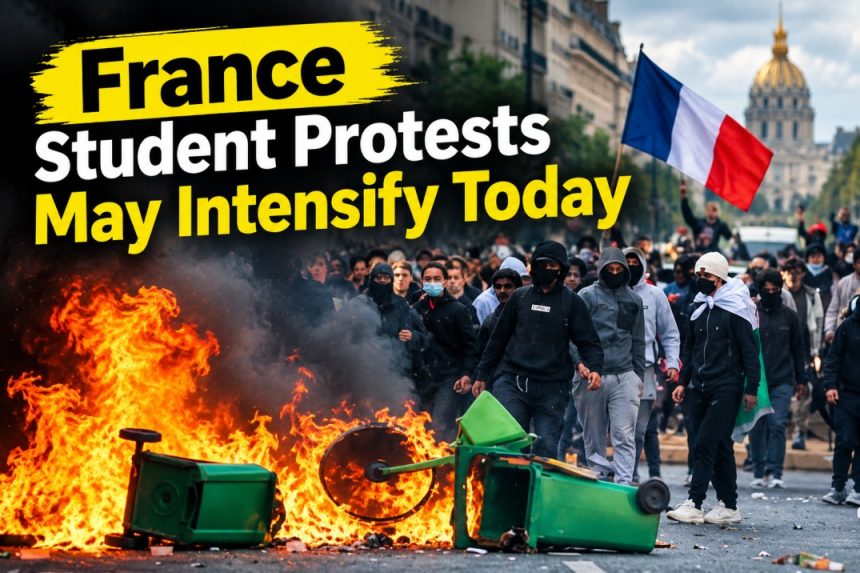
Paris: France is witnessing a fresh escalation of its nationwide student protest movement on Tuesday, October 6, as high-school students, university students and trade unions join forces for a major day of demonstrations. The protests, which began in September over worsening conditions in schools, have now entered their third week, with hundreds of schools still affected.
The significance of October 6 is growing as the movement moves beyond high schools and spreads into universities and the wider labour movement. France’s powerful CGT trade union has announced its support for the mobilisation, calling for workers to stand alongside high-school and university students.
🟡 From School Problems to a Nationwide Movement
The protests began with students raising concerns about teacher shortages, overcrowded classrooms, deteriorating school buildings, inadequate resources and difficult study conditions. Students have also complained about long school hours, inequality between schools in different areas and uncertainty over access to higher education.
The movement initially emerged around schools in the Paris region before spreading rapidly to other parts of France. By early October, protests and disruptions had been reported across a large number of secondary schools, turning what began as a localised education issue into a nationwide movement.
🟡 Hundreds of Schools Disrupted for More Than a Week
The impact on France’s education system has been substantial. On October 5, more than 400 secondary schools were fully or partially closed or disrupted, according to reports based on Education Ministry figures. Some schools have been affected for more than a week, while others have had classes suspended or moved online because of security concerns.
The disruption has raised concerns about the loss of teaching time, examinations and the ability of schools to maintain normal academic schedules. The government has also faced pressure to ensure that students can return to safe and stable learning environments.
🟡 Students Among Those Seriously Injured
The human cost of the unrest has become one of the most serious aspects of the crisis.
France’s Education Minister Édouard Geffray said on October 5 that 190 students had been injured since the protests began. Dozens of education workers have also been injured.
One of the most serious incidents occurred in Lens on October 5, when a 15-year-old student suffered the loss of his hand after a grenade exploded during a confrontation involving riot police. The exact circumstances are under investigation.
Another 14-year-old student was seriously injured in the face during a police intervention in Saint-Ouen-l’Aumône on September 28. According to his lawyer, he suffered a double jaw fracture and extensive dental injuries. French authorities have launched investigations into several incidents involving police action.
The injuries have intensified debate over the use of force during demonstrations, while authorities have also reported injuries among police officers and education staff.
🟡 What Are the Students Demanding?
Students are demanding more teachers and support staff, smaller class sizes and better-maintained school buildings.
They are also calling for improved study conditions, greater equality in education and changes to the university admission system known as Parcoursup. Student and trade-union groups argue that the existing system places additional pressure on young people and can reinforce social inequalities.
The CGT has also linked the protests to concerns over public spending and what it describes as pressure on public services.
🟡 Government Has Opened Talks — But No Final Solution Yet
The French government has acknowledged that many of the students’ concerns are legitimate. Prime Minister Sébastien Lecornu has held crisis discussions with ministers, while Education Minister Édouard Geffray has met student representatives.
The government has indicated that it intends to address issues including teacher replacement, school infrastructure and students’ concerns about their daily educational environment. However, the government has simultaneously condemned violence, vandalism and attacks on police or public property.
But the central issue remains unresolved: there is still no final agreement with the protesting students, and the movement has not been called off. Instead, student organisations are pressing ahead with the October 6 mobilisation, demanding concrete action rather than only discussions and announcements.
🟡 Why October 6 Matters
October 6 could therefore become an important turning point in the French education crisis. What began with students protesting conditions inside their schools has now expanded to include university students and major trade unions.
With hundreds of schools already disrupted, serious injuries reported and demonstrations continuing, the government faces pressure on two fronts: to respond to the underlying problems in the education system and to prevent further violence during the protests.
For now, however, the classrooms have not returned fully to normal, the students’ demands remain only partly addressed, and no final settlement has been reached. The scale of today’s October 6 mobilisation could determine whether the protests begin to lose momentum or enter an even broader phase.