


By | Pravin Kadam
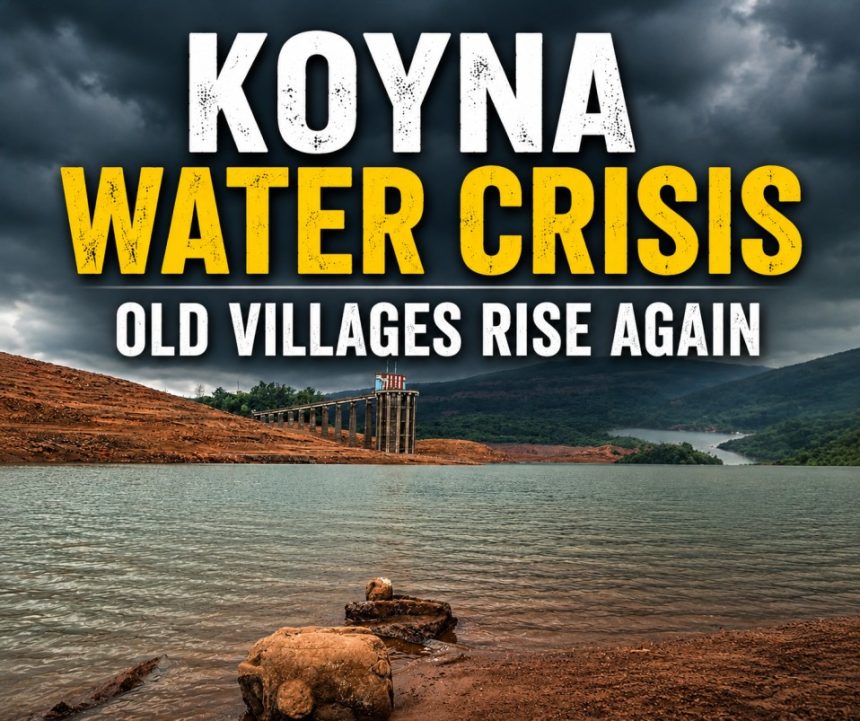
Satara – A sharp decline in water levels at the Koyna Dam has once again revealed long-submerged villages, roads, and structures in the Shivasagar reservoir, triggering fresh concerns about a possible water crisis in Maharashtra. The rare sight of resurfacing settlements has not only drawn attention but also revived memories of similar situations witnessed during past drought years.
🟡 Submerged History Comes Back to Surface
As water levels recede due to intense summer heat and reduced inflow, remnants of old villages—such as stone houses, wells, temple structures, and pathways—have begun to reappear. These villages were originally submerged during the construction of the dam in the 1960s, when thousands of residents were displaced to create the vast Shivasagar lake.
Locals describe the current visuals as both “rare and emotional,” as many families are witnessing traces of their ancestral homes after decades beneath the water.
🟡 Not the First Time: A Recurring Phenomenon
This is not an isolated incident. Similar resurfacing of submerged areas has been reported in earlier severe drought of 1972, when the first generation of rehabilitated families had also witnessed their old submerged villages reappear. Additionally, in 1999, during the fourth phase of the Koyna Hydroelectric Project, the reservoir’s water level was deliberately lowered for technical purposes to carry out lake tapping for power generation.” In 2015, drought years when the reservoir witnessed significantly low inflow. for instance, the Koyna region recorded one of the lowest inflow levels in its history, with water availability dropping drastically compared to normal averages.
During such periods, large portions of the reservoir bed become visible, exposing forgotten settlements and infrastructure. Experts say these occurrences are clear indicators of stress on the dam’s water storage system.
🟡 Fluctuating Water Levels: From Full Capacity to Concern
Interestingly, the Koyna Dam often shows extreme contrasts. During monsoon seasons, the reservoir can reach near or full capacity, supporting irrigation and power generation needs across Maharashtra. However, within months, heavy usage, evaporation, and weak inflow can lead to rapid depletion.
The dam, built on the Koyna River and considered the “lifeline of Maharashtra”, has a total storage capacity of over 105 TMC and plays a crucial role in hydroelectric power generation and irrigation.
This fluctuation highlights the region’s dependence on consistent monsoon rainfall.
🟡 Irrigation Demand Adding Pressure
Water from the Koyna reservoir is continuously released for irrigation in drought-prone regions like Sangli and parts of Satara district. While this supports agriculture, it also accelerates depletion during summer months. With rising temperatures and increasing demand, the current drop in water levels is being seen as a warning sign for the coming weeks.
🟡 Warning Signs of an Approaching Water Crisis
Officials and environmental experts are closely monitoring the situation. The resurfacing of submerged villages is being viewed as more than just a visual phenomenon—it is a strong indicator of declining reserves and potential water shortages if pre-monsoon conditions worsen.
Authorities have urged citizens to adopt water conservation practices and avoid unnecessary usage to manage the available supply efficiently.
🟡 Emotional Impact on Locals
Beyond the environmental concerns, the situation has also stirred deep emotions among displaced families. Many elderly residents recall their original homes, temples, and farmlands that were lost during the dam’s construction.
With these structures now visible again, some locals have started visiting the exposed sites, turning the moment into a mix of nostalgia and concern about the future.