


🔴 By | Arvind Jadhav
Prime Minister asks companies why tax concessions have not translated into higher salaries and more employment; opposition questions the government’s own job creation record.
🟡 Modi Questions Corporate India
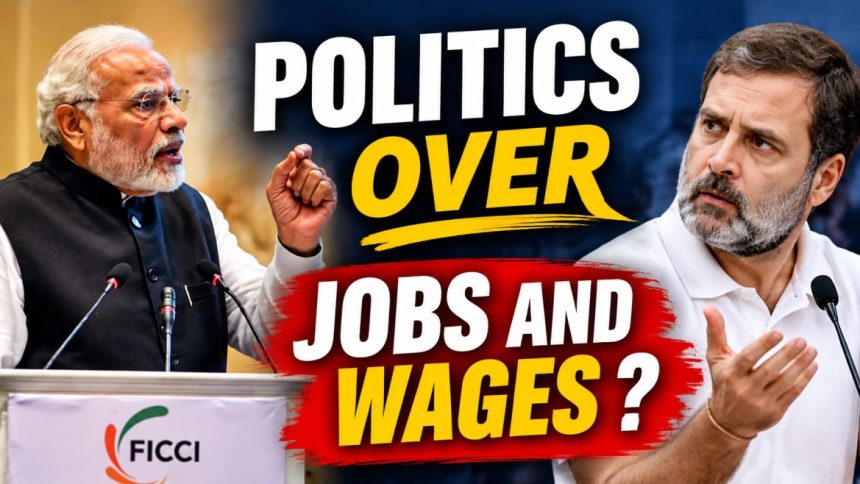
New Delhi : Prime Minister Narendra Modi has put India’s corporate sector under the spotlight by questioning whether major tax concessions provided by the government have resulted in more jobs and better salaries for employees. Addressing the FICCI Annual General Meeting and Annual Convention in New Delhi on November 19, 2026, Modi challenged business leaders to explain whether they had increased recruitment and employee wages after receiving substantial financial benefits.
🟡 Tax Benefits Versus Employee Salaries
Referring to the reduction in the basic corporate tax rate from 30 per cent to 22 per cent, Modi questioned whether companies had reciprocated the government’s support by expanding their workforce and improving employee compensation. He also highlighted income-tax relief under the new tax regime, under which eligible individuals earning up to ₹12 lakh annually can effectively pay zero income tax. His message was that businesses must contribute more directly to employment generation and workers’ financial well-being.
🟡 Corporate Profits and Wage Growth
The Prime Minister’s remarks have also drawn attention to the growing debate over corporate profitability and wage growth. According to a Financial Express analysis of 4,046 companies, employee wage bills increased by around 9 per cent in FY2025-26, while net profits rose nearly 19 per cent. These figures have renewed questions about how much of India’s corporate growth is reaching ordinary employees through higher incomes and better employment opportunities.
🟡 Congress Turns the Tables
The Congress party used the Prime Minister’s remarks to question the government’s employment record. Congress general secretary Jairam Ramesh criticised the government’s economic policies, arguing that concerns over stagnant wages and inadequate job creation had been raised by the opposition for years. The political debate has consequently shifted towards a larger question: whether responsibility for employment and wage growth should rest primarily with the government, private industry, or both.
🟡 Who Is Responsible for Job Creation?
Modi, meanwhile, urged corporate leaders to move beyond repeatedly seeking government concessions and take greater responsibility for India’s economic development. He called for increased domestic investment, stronger manufacturing capabilities and an India-first approach to long-term business decisions. The latest exchange has brought employment, salary growth and corporate accountability back into the national political debate, with the central question remaining whether India’s economic progress is translating into better livelihoods for its workforce.