

🔴 By |PR Network
New York – The United States is preparing for the Midterm Elections scheduled on November 3, 2026, a crucial democratic exercise that will determine control of Congress and significantly shape the country’s domestic and foreign policy, especially in the context of rising global war tensions. Unlike presidential elections, midterms do not elect a President but instead decide the balance of power in the legislative branch, which directly influences decisions on war funding, sanctions, and international strategy.
In the 2026 midterms, all 435 seats in the House of Representatives and approximately 35 seats in the 100-member Senate will be contested. Additionally, thousands of candidates will participate across federal, state, and local levels, with estimates suggesting that over 40,000 electoral positions will be on ballots nationwide, making it one of the largest democratic exercises in the world. The outcome of these elections will determine which party controls Congress for the next two years.
Currently, the political balance is highly competitive. The Republican Party holds an advantage in the Senate with roughly 53 seats compared to 47 held by Democrats (including independents), making the 2026 elections critical for any shift in power. In the House of Representatives, control is typically decided by narrow margins, and even a shift of a few seats can change the majority, increasing the stakes of every constituency.
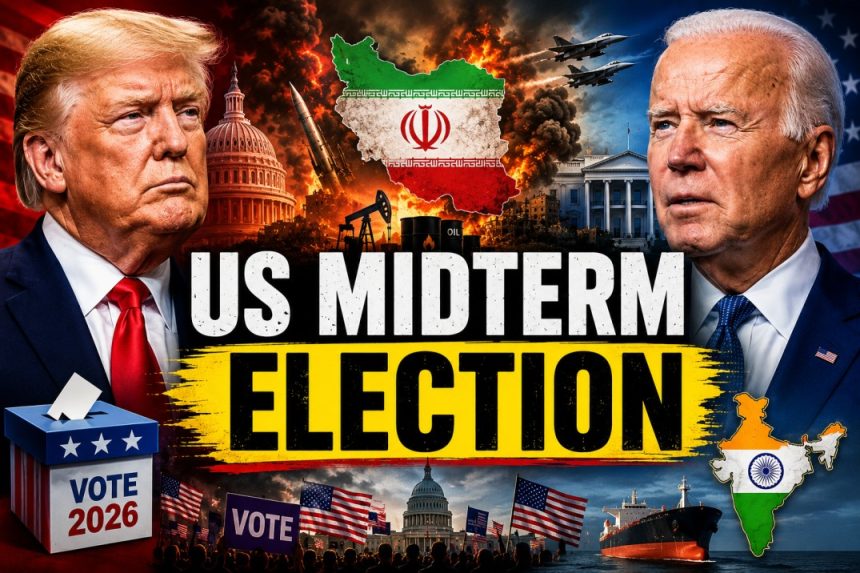
The Democratic Party, led by Joe Biden, faces the challenge of defending key Senate seats while attempting to regain or maintain control in both chambers. At the same time, the Republican Party, strongly influenced by former President Donald Trump, is aiming to strengthen its hold on Congress. Trump continues to play a major role in candidate selection and campaign narratives, making him a central force in the 2026 midterm elections despite not being on the ballot himself.
The backdrop of this election is the 2024 Presidential Election, which intensified political polarization in the United States and set the stage for a high-stakes midterm contest. Now, with global tensions rising—particularly involving Iran and ongoing conflicts in the Middle East—the 2026 elections are not just about domestic governance but also about America’s role in global conflicts.
One of the most critical issues influencing voters is the increasing tension between the United States and Iran. Strategic regions such as the Strait of Hormuz, through which a large portion of global oil supply passes, have become focal points of geopolitical concern. American public opinion is divided—while some voters support a stronger military stance, others are concerned about the economic consequences of war, including inflation and rising fuel prices.
If the Republican Party gains control of Congress, the United States may adopt a more aggressive approach toward Iran, including stricter sanctions, increased defense spending, and a more unilateral foreign policy stance. This could potentially escalate tensions in the Middle East and disrupt global energy markets.
On the other hand, if the Democratic Party retains control, the US is likely to continue its approach of balancing diplomacy with strategic pressure. This could involve working with international allies to manage the Iran situation while attempting to avoid direct large-scale conflict. However, even under Democratic leadership, geopolitical risks will remain high due to the volatile global environment.
The global implications of the 2026 midterm elections are significant. Control of Congress directly impacts decisions on military funding, international alliances, and sanctions. Any shift in US policy toward Iran could influence global oil prices, trade routes, and economic stability worldwide.
For India, these developments are particularly important. India imports nearly 85% of its crude oil, much of it from the Middle East. Any escalation in US-Iran tensions could lead to a sharp increase in oil prices, affecting inflation and economic growth. Additionally, fluctuations in the US dollar could put pressure on the Indian rupee.
India’s strategic partnership with the United States could also be influenced by the election outcome. A Republican-controlled Congress may lead to changes in trade and defense policies, while continued Democratic control may ensure stability in cooperation, especially in areas such as the Indo-Pacific region, defense collaboration, and technology partnerships.
The US Midterm Elections 2026 are not just about seats and candidates but about the direction of global power in a time of rising war tensions. With all 435 House seats and around 35 Senate seats at stake, and tens of thousands of candidates participating, the scale of this election reflects its importance. The results will shape not only America’s domestic future but also global geopolitical dynamics, with direct consequences for countries like India in terms of energy security, economic stability, and strategic positioning.