


🔴 By | Sonal Sharma
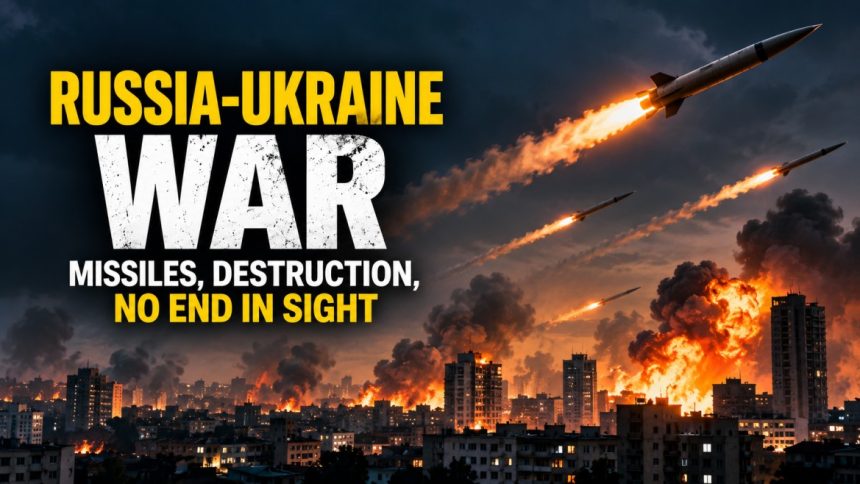
Moscow – The Russia-Ukraine war has entered another dangerous phase, with both sides intensifying long-range missile and drone attacks while diplomatic efforts to end the conflict continue to struggle.
The latest escalation has once again brought civilian casualties and destruction into focus. A Russian drone strike near Kyiv triggered a massive explosion at an ammunition storage facility, killing at least 37 people and injuring several others. Residential areas and other civilian facilities in the surrounding region were also damaged.
At the same time, Ukraine has stepped up its long-range drone campaign against Russian military, industrial and energy infrastructure. Ukrainian attacks have increasingly targeted oil refineries and other facilities considered important to Russia’s war effort.
🟡 War Spreads Beyond the Front Line
The conflict is no longer limited to trenches and battlefields in eastern and southern Ukraine.
Drones have become one of the defining weapons of the war. Russia has repeatedly launched large waves of drones and missiles against Ukrainian cities, energy facilities, warehouses and transport infrastructure.
Ukraine, meanwhile, has developed an increasingly sophisticated long-range drone capability and is attempting to strike targets deep inside Russian territory.
The result is a dangerous cycle of attack and retaliation, with civilians on both sides facing growing risks.
🟡 Ukraine Faces Massive Damage
The human and economic cost to Ukraine has reached extraordinary levels.
Thousands of homes, schools, hospitals, factories, roads, bridges, energy installations and other public facilities have been damaged or destroyed during the conflict.
Ukraine’s power infrastructure has repeatedly come under attack, creating serious challenges for electricity and heating supplies, particularly ahead of winter.
The destruction of transport, industrial and food-storage infrastructure has also placed additional pressure on Ukraine’s economy and everyday life.
The country’s reconstruction requirement is now estimated in the hundreds of billions of dollars, making rebuilding one of the biggest challenges Ukraine will face even after the guns fall silent.
🟡 How Did the War Begin?
The roots of the present conflict go back to 2014, when Russia annexed Crimea following political upheaval in Ukraine.
Armed conflict subsequently erupted in the Donbas region between Ukrainian government forces and Russia-backed separatists.
Internationally backed agreements attempted to stop the fighting, but a lasting political settlement could not be achieved.
Then, on February 24, 2022, Russia launched a full-scale invasion of Ukraine.
Russian forces advanced towards Kyiv and several other major Ukrainian cities during the early stage of the invasion. Ukraine resisted the advance, and Russian forces subsequently withdrew from areas around the capital.
The war then developed into a prolonged conflict centred largely on eastern and southern Ukraine.
🟡 Four Years of Destruction
What was initially expected by many to be a relatively short military campaign turned into a prolonged war of attrition.
The conflict has involved tanks, artillery, cruise missiles, ballistic missiles, combat aircraft, naval operations and—most significantly in recent years—massive numbers of drones.
Millions of Ukrainians have been displaced from their homes, while large numbers of families have lost relatives, homes and livelihoods.
Russia has also suffered significant military and economic costs, while international sanctions have fundamentally altered its economic relationship with Western countries.
🟡 Peace Efforts Yet to Deliver a Breakthrough
Despite repeated diplomatic initiatives, a permanent peace agreement remains out of reach.
The United States has continued efforts to bring Moscow and Kyiv towards negotiations, and discussions over a possible high-level meeting involving Russian President Vladimir Putin and Ukrainian President Volodymyr Zelenskyy have again gained attention.
However, fundamental disagreements remain.
Russia continues to demand major concessions relating to territory and Ukraine’s future security alignment, while Ukraine insists on protecting its sovereignty and refuses to surrender territory that remains under its control.
These differences remain one of the biggest obstacles to a comprehensive peace agreement.
🟡 Statements from the Leaders
Volodymyr Zelenskyy has repeatedly called for stronger international support for Ukraine’s air-defence systems and long-range capabilities, arguing that military pressure is necessary to protect Ukrainian civilians and force Russia towards meaningful negotiations.
Vladimir Putin, meanwhile, has maintained that Russia’s security concerns and military objectives must be addressed in any eventual settlement and has criticised Western military assistance to Ukraine.
Western governments continue to support Ukraine while simultaneously pressing for a diplomatic solution to the conflict.
🟡 A War With No Easy End
The Russia-Ukraine conflict has now become one of the most consequential wars of the 21st century.
It has changed Europe’s security architecture, disrupted global energy and food markets, triggered one of the largest displacement crises in modern European history and created a new era of drone warfare.
For Ukraine, the immediate priority remains survival and protection of its population.
For Russia, maintaining military pressure while dealing with the economic and strategic consequences of the war remains a major challenge.
And for the international community, the central question remains unchanged:
How can the war be brought to an end without creating the conditions for another conflict in the future?
Until that question is answered, missiles and drones are likely to continue speaking louder than diplomacy.