


🔴 By | PR Network
New Delhi: The United Nations has welcomed India’s approval of the Green Energy Corridor Phase-III (GEC-III), describing the massive grid-strengthening and battery storage programme as an important step towards harnessing the country’s rapidly expanding renewable energy capacity.
UN Climate Change Executive Secretary Simon Stiell said the initiative would help India meet its rising electricity requirements, support economic growth and further strengthen the country’s position as a global leader in solar energy. He also highlighted battery storage as strategically important for energy security in a large economy such as India.
🟡 From a 2012 Study to a National Green Power Network
The Green Energy Corridor is not a new initiative. Its foundation was laid in 2012, when Power Grid Corporation of India conducted a study that identified inadequate transmission infrastructure near potential large-scale solar and wind generation sites. Based on the study, dedicated transmission infrastructure was planned to move renewable electricity from generation centres to consumption centres. Implementation began in 2015.
The first phase focused on eight renewable-energy-rich states — Andhra Pradesh, Gujarat, Himachal Pradesh, Karnataka, Madhya Pradesh, Maharashtra, Rajasthan and Tamil Nadu. GEC Phase-I was designed to create around 9,700 circuit kilometres of transmission lines and 22,600 MVA of substations, enabling the integration of approximately 24 GW of renewable generation capacity.
Phase-II expanded the programme to Gujarat, Himachal Pradesh, Karnataka, Kerala, Rajasthan, Tamil Nadu and Uttar Pradesh. It envisages around 10,750 circuit kilometres of transmission lines and 27,500 MVA of substations to facilitate approximately 20 GW of renewable generation.
🟡 Global Financial Institutions Have Been Part of the Journey
The Green Energy Corridor has also developed with significant international financial and technical cooperation. Germany committed financial and technical assistance to the programme, while KfW provided concessional financing. Under GEC-I, KfW Germany provided a €500 million loan, alongside central government support and state transmission utility equity.
The Asian Development Bank (ADB) also became an important partner. Its Green Energy Corridor and Grid Strengthening Project included a $500 million loan and supported high-voltage transmission infrastructure designed to move renewable electricity from resource-rich areas to other parts of India. The project helped strengthen inter-regional connectivity and supported renewable energy investments in states such as Rajasthan and Gujarat.
KfW says its broader involvement in India’s green corridors has supported thousands of kilometres of transmission infrastructure and numerous substations, demonstrating that the development of India’s renewable-energy grid has attracted international financial and technical participation.
🟡 Phase-III: 135 GW Renewable Power and 50 GWh Storage
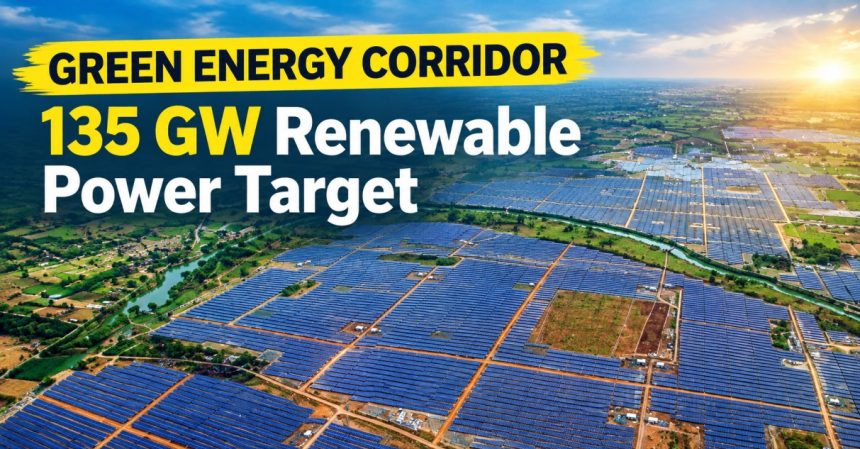
The Union Cabinet approved GEC Phase-III on September 30, 2026, with a total outlay of ₹1,86,405 crore. Of this, ₹1,36,378 crore is allocated for strengthening intra-state transmission systems, while ₹50,000 crore is earmarked for 50 GWh of Battery Energy Storage Systems. The scheme has central financial support of ₹54,082 crore and is targeted for completion by FY 2032-33.
The programme is designed to enable the evacuation of up to 135 GW of renewable energy and address one of the biggest challenges of the clean-energy transition: producing solar and wind power is only one part of the equation; the electricity must also be transmitted and stored efficiently when generation and demand do not match.
The battery storage component is particularly significant because solar generation is concentrated during daylight hours, while electricity demand continues after sunset. Large-scale storage can therefore provide greater flexibility to the grid and reduce renewable-energy curtailment.
🟡 Why the UN Reaction Matters
The UN’s response places the Indian initiative within a much larger global energy transition. Stiell has previously highlighted India’s rapid growth in solar capacity and described the country as a “solar superpower”, while stressing that stronger grids and energy storage will be crucial to converting renewable-energy growth into reliable economic and social benefits.
For India, therefore, Green Energy Corridor Phase-III is not simply another transmission project. It represents the next stage of a programme that began with identifying transmission bottlenecks more than a decade ago and has progressively expanded through domestic investment and international cooperation.
The success of Phase-III, however, will ultimately depend on timely execution, transmission infrastructure development, land and right-of-way clearances, and the effective deployment of battery storage. These implementation challenges have affected transmission projects in the past and will remain important as India attempts to integrate increasingly large volumes of renewable electricity into its power system.