


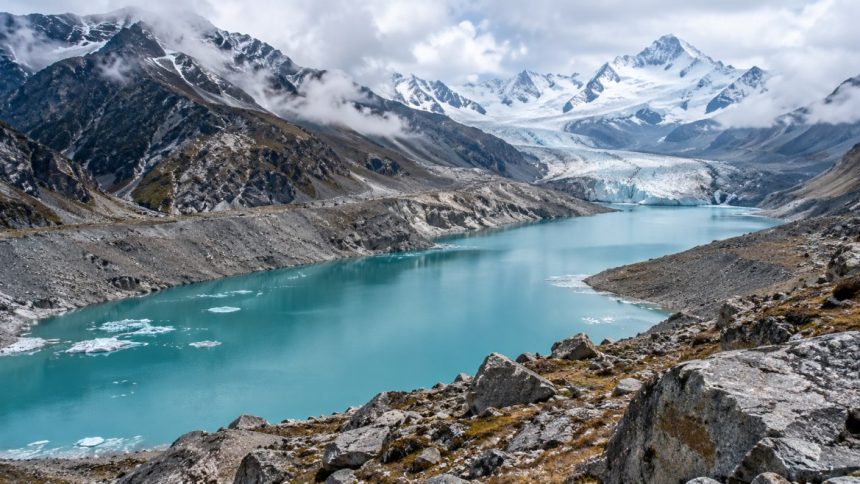
Bhutan GLOF triggers India alerts as Himalayan glacial lakes pose growing flood threats.
🔴 By | Arvind Jadhav
New Delhi : A sudden glacial lake outburst flood (GLOF) from Bhutan’s Sintaphu Lake on October 29 has brought renewed attention to the growing climate-related disaster risks facing the Himalayan region. The incident triggered downstream flood alerts in India’s West Bengal and Assam, highlighting how a natural event in one country can quickly become a disaster-management challenge for neighbouring nations.
According to the International Centre for Integrated Mountain Development (ICIMOD), Sintaphu Lake contained an estimated 6–7 million cubic metres of water before the outburst. The total volume released is still being assessed. Floodwaters damaged roads, bridges and public infrastructure in Bhutan’s Gasa and Punakha regions. No casualties were reported.
🟡 A New Lake Creates a Second Layer of Risk
One of the most significant developments following the outburst is the formation of a temporary lake downstream at Taktsemakhang, near the confluence of Sintaphu Chhu and Lungu Chhu. Bhutan’s National Centre for Hydrology and Meteorology is monitoring the newly formed water body because it could create another flood risk if its natural barriers become unstable.
This is an important aspect of glacial disasters that often receives less attention. An initial flood can carry enormous quantities of rocks, soil and debris downstream, blocking river channels and creating temporary water reservoirs. If these natural blockages suddenly collapse, another wave of flooding can occur.
🟡 India’s Himalayan Vulnerability: The Warning Is Bigger
The Bhutan incident is particularly significant for India because several Himalayan states depend on rivers originating in high-altitude glacier regions. West Bengal and Assam experienced precautionary alerts along the Sankosh river system. The river reportedly rose around 1.5 metres before beginning to recede. Thousands of residents were moved to safer locations as authorities monitored the situation.
The concern extends beyond this particular incident. A September 2026 assessment reported that Sikkim had identified 40 high-hazard glacial lakes, including 16 in its highest-risk Category A classification. The state is examining satellite monitoring, drainage improvements, flood-retention structures and stronger early-warning mechanisms.
The 2023 South Lhonak Lake disaster in Sikkim remains a major reminder of the consequences. The outburst caused extensive destruction, damaged infrastructure and destroyed the Chungthang dam, demonstrating how quickly a high-altitude disaster can affect settlements and critical infrastructure downstream.
🟡 Climate Change Is Only One Part of the Problem
Rising temperatures are accelerating glacier retreat and contributing to the formation and expansion of glacial lakes. However, the danger is not determined by lake size alone. The stability of natural barriers, surrounding mountain slopes, rock avalanches, landslides and the amount of water stored behind unstable moraine formations all influence the possibility of a sudden flood.
Another important concern is the growing combination of mountain hazards. The August 2026 disaster near the Nepal-China border involved a massive rock-and-ice collapse rather than a conventional glacial lake outburst. Scientists have warned that existing flood-warning systems may not adequately detect every type of sudden mountain collapse.
ICIMOD has documented 388 GLOF events across the Hindu Kush Himalaya region, including the Karakoram and the central and eastern Himalayas. Earlier assessments also identified 47 major potentially dangerous glacial lakes across the transboundary Koshi, Gandaki and Karnali river basins.
🟡 The Bigger Question: Are Governments Prepared?
The Bhutan incident demonstrates that early-warning systems can save lives when alerts reach vulnerable communities before floodwaters arrive. However, the long-term challenge is to move beyond emergency evacuation and develop a coordinated regional disaster-management strategy.
India, Bhutan and Nepal need stronger satellite surveillance, continuous lake-level monitoring, river-flow sensors, reliable communication networks and coordinated emergency-response mechanisms. Equally important is the protection of roads, bridges, hydropower projects and settlements located along vulnerable river valleys.
The central question is no longer simply whether another glacial lake will burst. It is whether governments and communities can identify the danger early enough to prevent a natural event from becoming a major human disaster.
The Himalayan glaciers are changing, and the consequences are no longer confined to remote mountain valleys. They are becoming a shared security, infrastructure and environmental challenge for the entire region.