

BJP-JD(S) sweep Karnataka, Samajwadi Party strengthens its position in Uttar Pradesh, Jan Suraaj opens its account in Bihar, and Congress retains Nagpur in a dramatic Maharashtra contest.
🔴 By | Arvind Jadhav
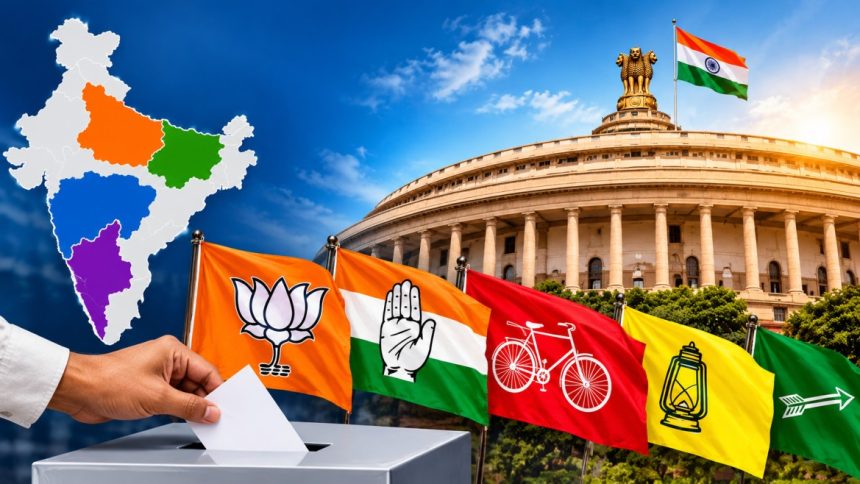
New Delhi : The results of the Legislative Council (MLC) elections across Maharashtra, Uttar Pradesh, Bihar and Karnataka have delivered a major political boost to the BJP-led National Democratic Alliance (NDA), while the Congress has suffered a significant setback. The NDA secured 16 of the 28 seats contested across the four states, according to published results. The Samajwadi Party (SP) strengthened its position in Uttar Pradesh, while Bihar witnessed a breakthrough for Prashant Kishor’s Jan Suraaj Party.
The elections, held on October 23, covered graduates’ and teachers’ constituencies, with counting beginning on October 27. The results have highlighted the importance of local political networks, candidate selection, alliance coordination and support among teachers and graduates. However, these elections represent a specific electorate and should not be treated as a direct prediction of future Assembly election outcomes.
🟡 Maharashtra MLC Results: Congress Wins Nagpur, Mahayuti Secures Two Seats
Maharashtra witnessed one of the most closely watched contests, with five Legislative Council seats at stake. The final outcome gave the opposition Maha Vikas Aghadi (MVA) three seats, while the ruling Mahayuti secured two.
Congress candidate Abhijit Wanjari retained the Nagpur Division Graduates’ constituency, defeating BJP candidate Sudhakar Kohale by 3,271 votes. Wanjari secured 67,231 votes against Kohale’s 63,960, following a counting process that extended beyond 40 hours. The result proved a setback for the BJP in Nagpur, the home turf of Chief Minister Devendra Fadnavis and Union Minister Nitin Gadkari.
The Nationalist Congress Party (Sharadchandra Pawar) secured victories in the Pune Graduates’ and Chhatrapati Sambhajinagar Graduates’ constituencies through Harshada Deshmukh-Jadhav and Pratapsinh Patil, respectively. The BJP won the Pune Teachers’ constituency through Kaustubh Gawade, while the Eknath Shinde-led Shiv Sena secured the Amravati Teachers’ seat through Kiran Sarnaik. The outcome also highlighted the challenges of maintaining coordination among Mahayuti partners in local contests.
🟡 Uttar Pradesh: BJP Wins Six Seats, Samajwadi Party Gets Five
Uttar Pradesh delivered a competitive result, with the BJP winning six of the 11 seats and the Samajwadi Party securing the remaining five. The results underline the BJP’s continued organisational strength, while the SP demonstrated its ability to challenge the ruling party in key teachers’ and graduates’ constituencies.
The SP’s victories in constituencies including Varanasi Teachers, Agra Teachers and Allahabad-Jhansi Graduates were politically significant. Varanasi, in particular, drew attention because of its association with Prime Minister Narendra Modi’s parliamentary constituency. The results provide the opposition with momentum ahead of the 2027 Uttar Pradesh Assembly elections, although the MLC verdict alone cannot determine the outcome of that larger electoral contest.
🟡 Karnataka: BJP-JD(S) Alliance Sweeps All Four Seats
The BJP-JD(S) alliance delivered a clean sweep in Karnataka, winning all four Legislative Council seats contested. The BJP retained the North-East Teachers’, South-East Graduates’ and West Graduates’ constituencies, while the Janata Dal (Secular) captured the Bengaluru Teachers’ seat.
JD(S) candidate A. P. Ranganath defeated sitting Congress MLC Puttanna by 908 votes in Bengaluru Teachers. The result was a setback for the Congress government in Karnataka, which failed to secure any of the four seats. The outcome also demonstrated the electoral advantage the BJP and JD(S) gained through their alliance in these constituencies.
🟡 Bihar: Jan Suraaj Opens Its Account in the Legislative Council
Bihar’s eight-seat contest produced a mixed verdict. The BJP won three seats, the Janata Dal (United) secured one, the Rashtriya Janata Dal won one, Jan Suraaj claimed one, and two seats went to independent candidates.
The most notable development was Jan Suraaj’s entry into the Bihar Legislative Council. Its candidate Suresh Prasad Rai defeated sitting Congress MLC Madan Mohan Jha in the Darbhanga Teachers’ constituency, giving Prashant Kishor’s party its first victory in the Upper House.
The RJD also registered an important win in the Patna Teachers’ constituency, where Sanjeev Kumar defeated veteran BJP MLC Nawal Kishore Yadav. These results reflected a diverse political contest in Bihar, where established parties faced challenges from both new entrants and independent candidates.
🟡 What the Results Mean for National Politics
The four-state MLC results offer a mixed picture for India’s major political parties. The BJP-led NDA emerged with the largest overall share of victories, benefiting from its performance in Karnataka, Uttar Pradesh and Bihar. At the same time, the Congress victory in Nagpur and the MVA’s three-seat tally in Maharashtra showed that opposition parties retained the ability to win important local contests.
The Samajwadi Party’s performance in Uttar Pradesh and Jan Suraaj’s breakthrough in Bihar are also significant developments. For the Congress, failing to secure a win in these elections represents an organisational challenge, particularly in Karnataka, where it governs the state.
The broader political implications will depend on how parties respond to the results, strengthen their local organisations and manage alliances ahead of upcoming elections. While the verdict gives the NDA a numerical advantage in this round of MLC polls, it also exposes the importance of constituency-level dynamics and the risks of assuming that state-level political dominance automatically translates into victories in every contest.
The results therefore offer an important snapshot of political strength among graduate and teacher voters across four states, rather than a definitive verdict on the national political mood.