


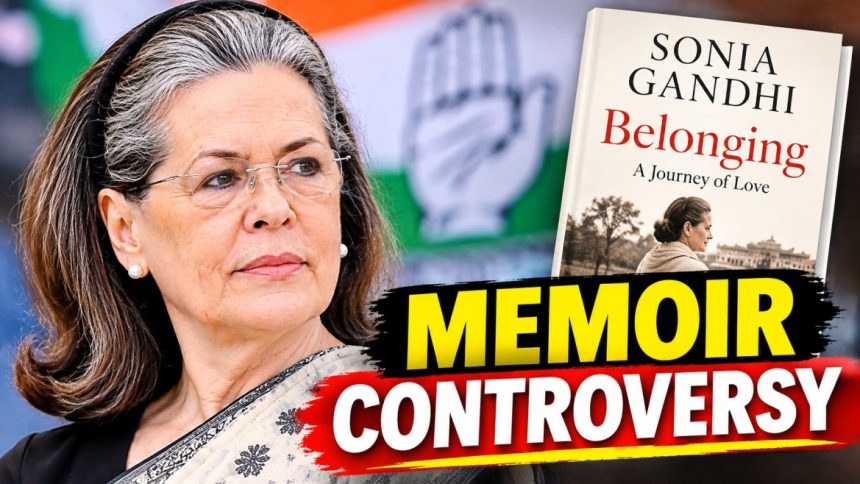
BJP questions historical accounts, JD(U) objects to Nitish Kumar references, while a media examination flags 55 factual and contextual issues in the book.
🔴 By | Arvind Jadhav
New Delhi : A new political controversy has erupted following the release of Congress Parliamentary Party chairperson Sonia Gandhi’s memoir, Belonging: A Journey of Love. The book, which hit the Indian market on November 10, 2026, has triggered sharp reactions from the BJP, Janata Dal (United) and other political leaders, turning a personal account of her life into a major national political debate.
The controversy revolves around Sonia Gandhi’s recollections of significant political events, including the 1984 anti-Sikh riots, the Emergency, the Babri Masjid controversy and the formation of the INDIA opposition alliance. While the BJP has questioned her interpretation of historical events, Congress leaders have accused the ruling party of politicising a personal memoir.
🟡 BJP Questions Sonia Gandhi’s Historical Accounts
The BJP has launched a strong attack on the memoir, alleging that Sonia Gandhi has attempted to soften the historical controversies associated with the Nehru-Gandhi family and the Congress party.
BJP national spokesperson C.R. Kesavan criticised the book, suggesting that it could have been titled ‘Whitewashing’. He questioned its treatment of the 1984 anti-Sikh riots, the Emergency imposed in 1975, the Babri Masjid issue and other politically sensitive developments.
BJP leader H.S. Phoolka also challenged Sonia Gandhi’s account of the 1984 violence, particularly her description of the government’s response and the allegations surrounding Rajiv Gandhi. Phoolka argued that her version did not accurately reflect the historical record.
The BJP has also questioned the memoir’s references to Operation Blue Star, the Batla House encounter and the 26/11 Mumbai terror attacks.
🟡 Congress Rejects BJP’s Criticism
Congress leaders have rejected the BJP’s allegations, maintaining that the memoir is a personal account of Sonia Gandhi’s experiences rather than a political campaign document.
Sonia Gandhi has described the 1984 anti-Sikh violence as a tragic and shameful chapter, criticised the failure of authorities to prevent the killings and acknowledged the delay in delivering justice.
She has also described the Emergency as a mistake, while portraying Indira Gandhi’s political circumstances during that period.
Congress leaders argue that the BJP is attempting to turn personal recollections into a political confrontation instead of discussing the wider context of the book.
Nitish Kumar’s INDIA Alliance Role Becomes Another Flashpoint
🟡 The controversy has also reached Bihar’s political landscape.
In her memoir, Sonia Gandhi reportedly suggests that Bihar Chief Minister Nitish Kumar was looking for an opportunity to leave the INDIA opposition alliance and was under the influence of the BJP.
JD(U) working president Sanjay Kumar Jha objected to this portrayal. He maintained that Nitish Kumar played an important role in bringing opposition parties together and initiating the process that led to the formation of the INDIA alliance.
Jha also questioned Sonia Gandhi’s account of her decision not to become Prime Minister after the 2004 general election, stating that Mulayam Singh Yadav had not supported her candidature at the time.
The JD(U)’s response has added another dimension to the controversy, particularly because Nitish Kumar’s role in opposition unity remains a politically significant issue.
55 Factual and Contextual Issues Reported in the Memoir
Adding to the political debate, an extensive examination published by India Today on November 11 identified 55 factual and contextual issues in the memoir.
🟡 Some of the discrepancies concern verifiable historical and constitutional details.
The book reportedly gives 1921 as the founding year of the Rashtriya Swayamsevak Sangh (RSS), whereas the organisation was established in 1925.
Another discrepancy concerns former Congress leader Ahmed Patel, whose death is mentioned as having occurred in 2022, although he died on November 25, 2020.
The examination also raises questions about the description of Rajya Sabha membership, the 2014 general election results, the Kargil conflict and certain judicial developments.
For example, the book reportedly gives the NDA’s 2014 Lok Sabha tally as 353 seats, whereas the alliance actually won 336 seats. It also describes Rajya Sabha members as nominated, although the majority are indirectly elected.
NDTV has independently highlighted some historical inaccuracies, including the incorrect year associated with Anna Hazare’s anti-corruption movement.
These are findings from media examinations of the memoir and should not be interpreted as an official assessment of every passage in the book.
🟡 Memoir Also Reveals Personal and Political Experiences
Titled Belonging: A Journey of Love, the 526-page memoir traces Sonia Gandhi’s journey from her childhood in Italy to her marriage to former Prime Minister Rajiv Gandhi and her subsequent entry into Indian politics.
The book also discusses her relationship with Indira Gandhi, the assassination of Rajiv Gandhi, her decision to remain away from the Prime Minister’s post in 2004 and her experiences as Congress president.
Sonia Gandhi has described the book as a personal account of family, love, loss and her journey towards finding a home in India.
🟡 Political Debate Intensifies Ahead of Next Developments
The controversy surrounding the memoir has now extended beyond the BJP and Congress, with JD(U) leaders also questioning its political interpretations.
The book is scheduled to be formally marked at a Delhi event on November 16, which is expected to be attended by Rahul Gandhi, Priyanka Gandhi Vadra and Congress president Mallikarjun Kharge.
Whether the political exchanges will intensify further following the event remains to be seen. For now, Sonia Gandhi’s memoir has generated a wider debate over historical interpretation, political accountability and the accuracy of personal recollections involving major national events.