


🔴 By | Arvind Jadhav
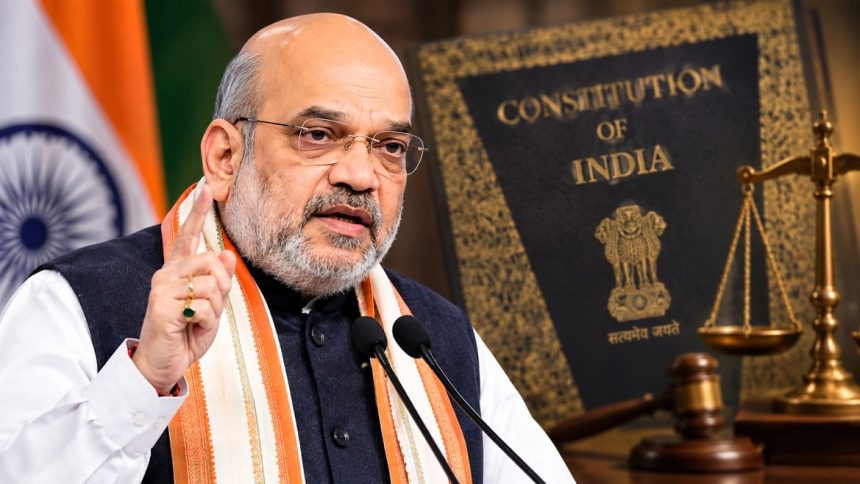
Mumbai: The Uniform Civil Code (UCC) has once again moved to the centre of India’s political and constitutional debate after Union Home Minister Amit Shah announced in Mumbai that NDA-ruled states will move towards implementing the Uniform Civil Code before the 2029 Lok Sabha elections.
The announcement gives a fresh political deadline to an issue that has remained part of India’s constitutional discussion for decades. For the BJP and its supporters, the UCC represents a major step towards ensuring that citizens have the same civil rights irrespective of their religion.
The proposed framework is expected to cover important aspects of personal life, including marriage, divorce, inheritance, succession and family-related laws.
🟡 UCC: A Constitutional Commitment Since Independence
The idea of a Uniform Civil Code is not new. It was discussed extensively during the making of the Indian Constitution and was eventually incorporated into Article 44, which directs the State to endeavour to secure a Uniform Civil Code for citizens throughout India.
India currently follows different personal-law systems in several areas depending on religion and community. Supporters of the UCC argue that while religious beliefs can remain different, civil rights and legal protections should be common for every citizen.
This is the central argument behind the current push for a Uniform Civil Code: different faiths, but equal civil rights.
🟡 From Shah Bano to Triple Talaq
The UCC debate became particularly prominent following the Supreme Court’s Shah Bano judgment in 1985.
The case triggered a nationwide debate about the rights of divorced Muslim women, personal laws and the relationship between religious practices and constitutional principles.
The issue returned to the political centre years later with the debate over triple talaq. The abolition of instant triple talaq was presented by the BJP government as an important measure for protecting Muslim women from what it described as a discriminatory practice.
For UCC supporters, these developments strengthened the argument that civil and family laws should provide equal protection to women regardless of their religion.
🟡 BJP’s Main Argument: Equality Before Different Personal Laws
The BJP has consistently maintained that India cannot have different standards of civil rights based on religion.
Its argument is straightforward: religious practices and worship can remain protected, but matters such as marriage, divorce, inheritance and succession should be governed by a common framework that gives citizens equal legal rights.
Supporters believe this can make the legal system simpler and more consistent while strengthening gender equality and women’s rights.
They also argue that a common civil framework could reduce contradictions between different personal-law systems and establish a clearer principle of equality before civil law.
🟡 Why Has the UCC Faced Opposition?
Despite strong support from the BJP and sections of civil society, the UCC has also attracted opposition.
Critics argue that personal laws are connected with religious and cultural traditions and that excessive uniformity could interfere with constitutionally protected freedoms.
Another concern is India’s enormous diversity. Different communities, particularly tribal groups, have their own customary practices concerning marriage, inheritance and family relationships.
These concerns mean that the implementation of the UCC will require careful drafting and consultation rather than simply replacing every existing practice with one rigid national formula.
🟡 The Tribal and Cultural Challenge
The question of tribal communities is particularly significant.
India’s tribal population includes communities with distinct customs and traditional systems of social organisation. Any UCC therefore has to balance the principle of uniformity with constitutional protections available to certain communities.
This does not necessarily weaken the concept of UCC. Instead, it highlights the challenge of creating a law that delivers equal civil rights while respecting legitimate constitutional protections and traditional identities.
🟡 Uttarakhand Opens a New Chapter
The UCC debate is no longer limited to Parliament or election manifestos.
Uttarakhand became the first state to implement a comprehensive Uniform Civil Code framework. Gujarat and Assam have subsequently moved in the same direction.
These developments have provided an opportunity to examine how common civil rules can actually operate at the state level.
They also offer valuable lessons about registration, marriage, inheritance, succession, implementation and the treatment of customary practices.
🟡 Why Amit Shah’s 2029 Timeline Matters
Amit Shah’s latest announcement gives the UCC issue a clear political timeframe.
If the NDA succeeds in introducing similar frameworks across its state governments before the 2029 Lok Sabha elections, the UCC could become one of the most significant legal and political reforms of the current decade.
For the BJP, the issue fits into a broader reform narrative centred on equality, women’s rights and uniform civil rights.
For the opposition, however, the focus is likely to remain on religious freedom, minority concerns, cultural diversity and the protection of customary laws.
The political debate is therefore likely to intensify as individual states begin preparing their legislation.
🟡 The Bigger Question: What Will the UCC Actually Look Like?
The most important part of the debate is now shifting from the slogan of “Uniform Civil Code” to the actual contents of the proposed law.
Will the same rules apply equally to every citizen? What will happen to existing personal laws? Which customary practices will receive protection? How will tribal communities be treated? And how will women’s rights, religious freedom and constitutional safeguards be balanced?
These questions will determine the success of the UCC more than political speeches alone.
🟡 A Long-Pending Reform Moves Towards Reality
The Uniform Civil Code has travelled from Article 44 of the Constitution to a major political commitment and, in some states, to actual legislation.
Amit Shah’s Mumbai announcement has now added a fresh deadline and could make UCC one of the defining political issues before 2029.
For supporters, it is an opportunity to establish a basic principle — one country may have many religions and traditions, but its citizens should enjoy equal civil rights.
For critics, the challenge is to ensure that uniformity does not come at the cost of legitimate constitutional and cultural protections.
The coming years will therefore determine whether the UCC becomes one of India’s most significant steps towards civil-law equality — and whether that equality can be achieved while preserving the country’s remarkable diversity.