

🔴 By | Arvind Jadhav
🟡 U.S.-Led ‘Board of Peace’ Announces Breakthrough
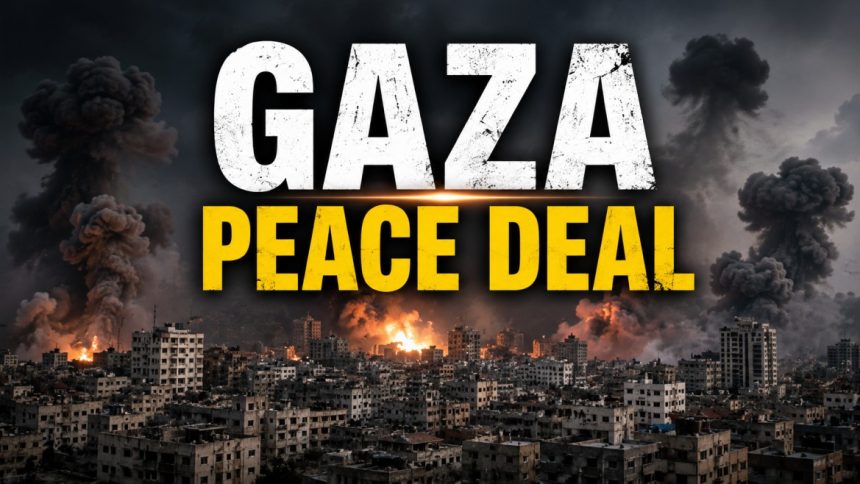
A major diplomatic development has emerged in the ongoing Gaza conflict, with U.S. President Donald Trump announcing that the international “Board of Peace” has reached a tentative agreement aimed at disarming Hamas and ending hostilities in the region. According to Reuters, the proposed deal outlines a phased disarmament of Hamas and other armed groups, alongside a gradual withdrawal of Israeli forces from Gaza.
🟡 Phased Disarmament and Israeli Withdrawal Plan
As per international reports, the agreement includes a structured roadmap in which Hamas would dismantle its weapons infrastructure—including tunnels and stockpiles—in stages, while Israeli troops withdraw in parallel. The plan is expected to be monitored by an international stabilization force and supported by a newly formed Palestinian security mechanism.
However, the timeline and implementation details remain unclear, with U.S. officials indicating that full disarmament could take several months and would require verification at each stage.
🟡 Hamas Response and Conditional Acceptance
Reports suggest that Hamas has shown conditional willingness to engage with the proposal. According to The Wall Street Journal and other international outlets, the group has linked disarmament to a complete Israeli withdrawal and security guarantees.
Hamas has also indicated that any surrender of weapons could be managed under a Palestinian-led mechanism rather than direct Israeli oversight, highlighting the fragile nature of the negotiations.
🟡 Israel Yet to Fully Approve Proposal
Despite the announcement, Israel has not formally approved the deal. Officials have reportedly expressed concerns over whether the proposed disarmament measures meet their core demand of complete demilitarization of Gaza before any withdrawal.
This divergence remains one of the biggest obstacles to implementing the agreement, with both sides maintaining firm positions on security and control.
🟡 Governance Transition Under Discussion
Parallel to the security arrangements, the peace framework includes a transition in Gaza’s governance. Earlier developments reported by Reuters and AP News indicate that Hamas had dissolved its administrative structure in Gaza and signaled readiness to transfer authority to a technocratic Palestinian committee under international supervision.
This proposed governance model is expected to function under the broader oversight of the “Board of Peace,” ensuring administrative continuity and reconstruction efforts.
🟡 International Role and Stabilization Force
The plan also envisions the deployment of a multinational stabilization force to maintain order during the transition period. Reuters reports that Israel has already approved a legal framework allowing such a force to enter parts of Gaza as part of the broader ceasefire arrangement.
In addition, mediators including Egypt, Qatar, and Turkey have been credited with facilitating negotiations between the parties.
🟡 Ground Situation Remains Fragile
Despite diplomatic progress, the situation on the ground remains volatile. Reports indicate that violence has continued in parts of Gaza even as negotiations advance, underlining the gap between political agreements and real-time conditions.
The conflict, which escalated after the October 2023 attacks, has caused widespread destruction and a severe humanitarian crisis, making a durable ceasefire critical for the region’s stability.
🟡 Conclusion: Progress with Persistent Challenges
While the “Board of Peace” initiative marks a significant step toward a possible resolution, major uncertainties remain. Key issues such as verification of disarmament, mutual trust deficits, and political acceptance by both Israel and Hamas continue to pose challenges.
As of July 2026, the proposed deal represents a potential breakthrough, but its success will depend on sustained negotiations, international oversight, and on-ground implementation in one of the world’s most complex conflict zones.