


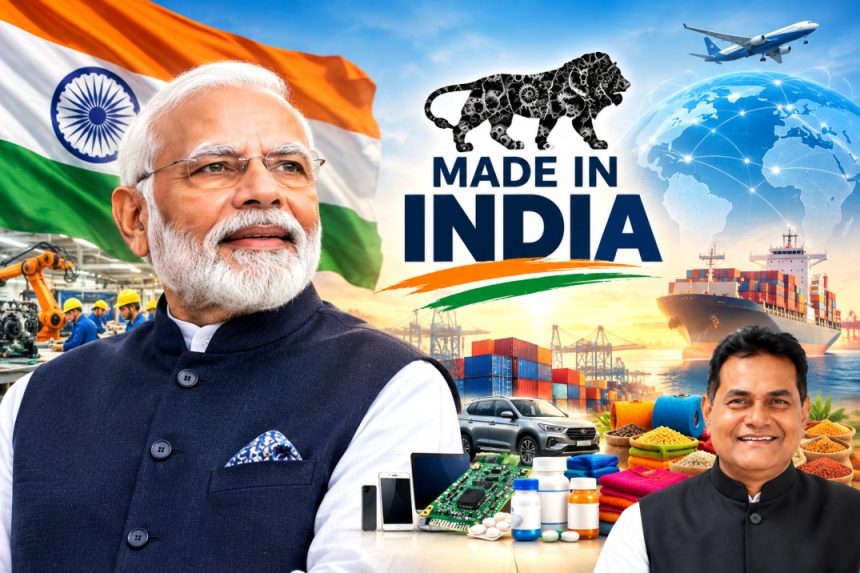
Mumbai: Former Mumbai Deputy Mayor and Shiv Sena leader Babubhai Bhavanji has said that India’s growing economic influence is increasingly visible across global markets. According to Bhavanji, the growing demand for Indian products in major economies, including the United States and China, reflects the expanding reach of ‘Made in India’.
Bhavanji said India’s merchandise exports recorded a sharp 26.12% year-on-year increase in August 2026, rising to $43.81 billion from $34.74 billion in August 2025. At the same time, merchandise imports increased by 14.05% to $70.67 billion. The merchandise trade deficit stood at $26.86 billion, slightly lower than $27.20 billion a year earlier.
🟡 US market drives export momentum
Bhavanji said the United States continued to remain one of India’s key export destinations. India’s merchandise exports to the US rose by more than 21% in August, reaching around $8.3 billion, compared with about $6.8 billion during the same month last year. The increase came amid a significantly lower tariff burden compared with August 2025.
He said the depreciation of the rupee also contributed to the competitiveness of Indian goods in overseas markets. The weaker currency can make Indian products relatively cheaper for foreign buyers, particularly in sectors where export demand is sensitive to price.
🟡 Engineering and electronics show strong growth
According to Bhavanji, the latest export figures also indicate stronger performance in several technology and manufacturing-oriented sectors. Government data shows that engineering goods exports increased 24.86%, rising from $9.87 billion in August 2025 to $12.32 billion in August 2026. Organic and inorganic chemical exports also increased by 16.38% to $2.80 billion.
Electronics, engineering products, automobiles and pharmaceuticals have also contributed to the broader export momentum. The expansion of these sectors is significant as India seeks to increase its share in global manufacturing and supply chains.
🟡 China and other markets also record growth
Bhavanji pointed to the increase in Indian exports to several major overseas markets as another indication of wider market diversification. He said exports to China have also recorded significant growth, while countries in Asia, Europe and other regions continue to provide additional opportunities for Indian exporters.
The Federation of Indian Export Organisations has also highlighted the broadening of India’s export markets along with strong growth in sectors such as automobiles, gems and jewellery and chemicals.
🟡 Not every sector is growing at the same pace
Bhavanji, however, said the export picture is not uniform across all sectors. Labour-intensive industries and certain traditional export segments continue to face pressure from international competition and changing global demand.
The latest data shows that India’s export growth is being supported particularly by engineering products, chemicals and other higher-value segments, while some traditional sectors have experienced weaker performance. This indicates that the composition of India’s export basket is also undergoing changes.
🟡 Imports rise, but gold imports fall sharply
India’s merchandise imports stood at $70.67 billion in August 2026, compared with $61.96 billion in August 2025. However, the sharp fall in gold imports helped contain the overall increase in imports. Gold imports fell to around $2.3 billion, significantly below the corresponding level a year earlier.
Overall, India’s merchandise and services exports were estimated at $82.68 billion in August 2026, registering growth of 25.41% over August 2025. Total imports were estimated at $92.09 billion, leaving the overall trade deficit at $9.41 billion.
Bhavanji said the latest figures underline the growing importance of Indian manufacturing and exports in the global economy. He said continued expansion into new markets, stronger domestic manufacturing and increasing demand for Indian engineering, electronics, pharmaceutical and other value-added products could further strengthen the global presence of ‘Made in India’.