


🔴 By | Arvind Jadhav
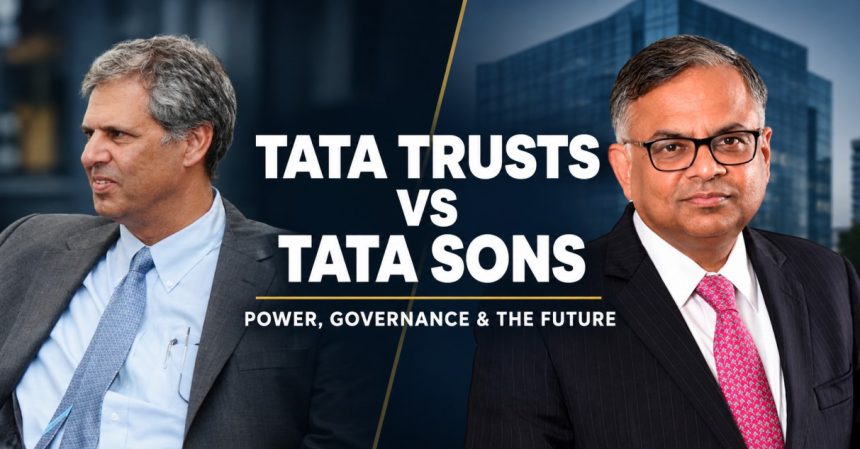
Mumbai : The Tata Group is facing an unusually serious internal governance dispute, and the latest developments suggest that the issue is no longer limited to the reappointment of Tata Sons Chairman N. Chandrasekaran. The confrontation between Tata Trusts Chairman Noel Tata and the Tata Sons board has now expanded into a larger debate over corporate control, special voting rights, the future structure of Tata Sons and whether the group’s principal holding company should remain private or move towards a stock-market listing.
The immediate dispute erupted after the Tata Sons board approved another five-year term for N. Chandrasekaran on September 17, 2026. Tata Trusts, which collectively hold about 66% of Tata Sons, opposed the decision. Noel Tata argued that the resolution did not satisfy the requirements of Tata Sons’ Articles of Association because the two Trust-nominated directors did not both support the proposal. The two nominees reportedly voted differently, with Noel Tata opposing the reappointment while Venu Srinivasan supported it. Tata Sons, however, maintains that the board decision was legally valid.
🟡 The Chandrasekaran Question Is Only One Part of the Larger Dispute
At the heart of the controversy is Article 121 of Tata Sons’ Articles of Association. Tata Trusts argues that certain important decisions require not only a majority of the Tata Sons board but also affirmative support from the required majority of directors nominated by the Trusts. The Trusts therefore contend that a general board majority, or the use of a chairman’s casting vote, cannot replace the specific approval required under the Articles.
Tata Sons has taken a different legal position and has maintained that Chandrasekaran’s reappointment was valid under its governance framework. This difference in interpretation is significant because it raises a fundamental question: when the majority shareholder’s nominated directors disagree among themselves, how should the special voting provisions in Tata Sons’ Articles operate?
The issue has also brought the 2021 Supreme Court judgment in the Cyrus Mistry case back into focus. The Supreme Court had upheld the validity of special affirmative voting rights enjoyed by Tata Trusts’ nominee directors. Tata Trusts is now relying on that legal history to argue that these rights cannot simply be bypassed when a major governance decision is taken. However, the 2021 judgment did not directly decide the present Chandrasekaran dispute. The precise application of those provisions to the September 17 resolution remains a separate legal question.
🟡 The Bigger Battle: Should Tata Sons Remain Private?
The second and potentially more consequential issue is the future of Tata Sons itself.
The Reserve Bank of India has rejected Tata Sons’ request to surrender its registration under the regulatory framework applicable to upper-layer non-banking financial companies. The regulatory position has therefore created pressure on Tata Sons to comply with the applicable rules, including the possibility of a public listing.
The Tata Sons board has moved towards preparing for a listing, while Tata Trusts has opposed listing and argued that the century-old Tata structure should be preserved. Tata Trusts has said that the group should examine alternatives rather than treating a stock-market listing as the only route forward.
This is where the dispute becomes much bigger than the question of who occupies the chairman’s office. A listing could change the ownership and governance dynamics around Tata Sons and potentially introduce a new layer of public-market scrutiny. For Tata Trusts, preserving the existing Tata model appears to be a central consideration.
🟡 September 28 Move Changes the Equation
The most important new development came on September 28, when Tata Trusts proposed a restructuring of Tata Sons involving the merger of Tata Electronics Systems Solutions Private Limited and Tata Consulting Engineers with Tata Sons.
The objective is to change the nature of Tata Sons sufficiently so that the reorganised entity could potentially fall outside the regulatory definitions that have created the listing issue. Tata Trusts has proposed seeking the Reserve Bank’s prior approval or no-objection for the restructuring. If implemented, the plan could allow Tata Sons to remain unlisted while addressing the regulatory problem through a fundamentally different corporate structure.
But this proposal is not an automatic solution. The Tata Sons board would have to consider it, and regulatory approval would remain an important step. Experts have also pointed out that changing the structure of the holding company to move outside the relevant regulatory framework could itself face legal and regulatory questions.
🟡 Why This Could Become a Long Governance Battle
The present confrontation is unusual because Tata Trusts is not an ordinary minority shareholder challenging management. It is the majority shareholder in Tata Sons and has historically enjoyed special rights embedded in the company’s Articles.
At the same time, Tata Sons has its own board and management structure, and the current board has publicly defended the validity of its decisions. The result is a complicated balance between ownership, board authority, constitutional documents and regulatory requirements.
The dispute also carries historical significance. The Tata Group has already experienced a major governance battle in the Cyrus Mistry episode. The present disagreement is different in its facts and circumstances, but once again the central question is how power should be distributed between the Tata Trusts, the holding company and its board.
🟡 What Happens From Here?
Three developments will be particularly important. First, the legal position surrounding Chandrasekaran’s reappointment will have to be clarified, especially the interpretation of Article 121 and the role of the chairman’s casting vote. Second, the Tata Sons board will have to consider Tata Trusts’ proposed restructuring involving TESS and Tata Consulting Engineers. Third, the Reserve Bank’s response will determine whether the proposed restructuring can actually provide a route for Tata Sons to remain outside the listing requirement.
For the Tata Group, therefore, this is not simply a clash between Noel Tata and N. Chandrasekaran. It is a contest over the interpretation of the Tata Sons governance framework and the future architecture of one of India’s most important business groups.
The immediate personalities may dominate the headlines, but the deeper issue is institutional: who ultimately has the decisive say over Tata Sons when the majority shareholder, its nominated directors and the company’s board take different positions?
That question is now at the centre of the Tata Trusts–Tata Sons confrontation, and the answer could shape the governance model of the Tata Group for years to come.