

🔴 By | Arvind Jadhav
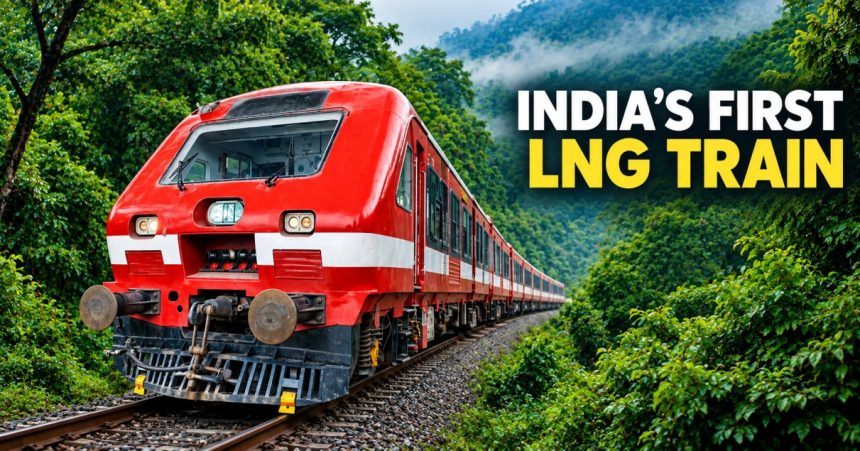
Ahmedabad: Indian Railways is set to take another significant step towards alternative-fuel technology with the launch of the country’s first LNG-based dual-fuel DEMU train. Union Home and Cooperation Minister Amit Shah is scheduled to flag off the train from Sabarmati Railway Station, marking a major development in India’s efforts to reduce dependence on conventional diesel fuel.
The new train has been developed to operate on a dual-fuel system using Liquefied Natural Gas (LNG) and diesel. The initiative is aimed at reducing diesel consumption, lowering fuel expenditure and cutting emissions from railway operations. The train is planned to operate on the Sabarmati–Patan route after its formal launch.
🟡 Two 1,400 HP Power Cars Converted to LNG Technology
The project has been developed at the Integrated Coaching Depot in Sabarmati, where two Driving Power Cars (DPCs), each equipped with a 1,400 HP engine, have been converted to operate with LNG and diesel.
The dual-fuel technology allows LNG to substitute for a significant portion of diesel consumption without requiring the train to depend entirely on a single fuel. According to project details reported from Gujarat, LNG can replace up to around 40 per cent of diesel consumption under the system.
Both power cars have reportedly completed more than 2,000 km of field trials before being prepared for regular railway operations.
🟡 Fuel Savings Could Reach ₹23.9 Lakh a Year
One of the major objectives behind the project is to reduce the railway’s fuel bill.
Testing and project estimates indicate that each Driving Power Car could generate annual fuel savings of approximately ₹11.9 lakh. For an eight-coach DEMU rake, the projected annual saving could reach approximately ₹23.9 lakh.
The financial benefit will depend on actual operating conditions, fuel prices, LNG availability and the proportion of LNG used during regular service.
🟡 Why LNG Is Important for Indian Railways
LNG is being explored as an alternative fuel because it can provide a higher fuel-carrying capacity compared with compressed natural gas in applications where onboard storage is a major consideration.
The Sabarmati project therefore represents more than just the introduction of another train. It is also a technology demonstration aimed at examining how alternative gaseous fuels can be integrated into railway operations that traditionally depend on diesel.
The project is expected to contribute to lower emissions of carbon dioxide, nitrogen oxides and particulate matter, while also helping reduce diesel consumption.
🟡 High-Speed Trials Also Conducted
The LNG dual-fuel DEMU has undergone technical and performance testing, including high-speed trials. Reports from Gujarat state that the train reached speeds of up to 222 kmph during testing.
The trials were intended to examine the performance of the modified propulsion system and its operational behaviour under different conditions before the technology was introduced into regular railway service.
🟡 Sabarmati Becomes the Centre of a New Railway Fuel Experiment
The choice of Gujarat for the project is also significant because of the availability of LNG infrastructure in the state. Reports have indicated that LNG supply arrangements linked to Mundra Port provide an important logistical advantage for the project.
Following the initial deployment, Western Railway is also reported to be considering the conversion of additional DEMU power cars to LNG-based dual-fuel technology. This could provide Indian Railways with operational experience before any wider expansion of the system.
🟡 An Important Clarification: CNG and LNG Are Not the Same
The September 27 launch should not be described as the launch of India’s first CNG train.
India’s first CNG-based train was launched in January 2015 on the Rewari–Rohtak section. That train used a diesel-CNG dual-fuel system and was introduced under Indian Railways’ efforts to reduce diesel consumption and greenhouse-gas emissions.
The new 2026 project is different. It is being introduced as India’s first LNG-based dual-fuel DEMU, combining LNG with diesel and representing a new stage in the railway’s alternative-fuel programme.
🟡 A New Chapter in India’s Green Rail Strategy
Indian Railways has been increasingly focusing on reducing its dependence on conventional fossil fuels through electrification, alternative fuels and newer propulsion technologies.
The LNG DEMU comes at a time when Indian Railways is also experimenting with other clean-energy technologies. In July 2026, the government announced India’s first hydrogen fuel-cell trainset, reflecting the wider push towards cleaner forms of railway transportation.
The today’s launch from Sabarmati will therefore be closely watched as a practical test of LNG technology in everyday railway operations.