


🔴 By | Arvind Jadhav
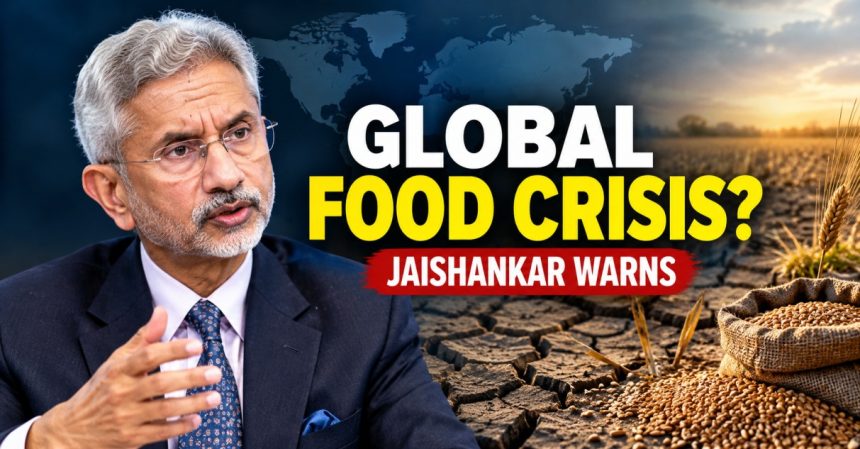
New York : External Affairs Minister S. Jaishankar has warned that the world could face a major food crisis in the coming months, as ongoing conflicts, disrupted grain shipments, fertiliser shortages and growing climate risks put increasing pressure on global food security. His warning came during an interaction at the Asia Society in New York following the United Nations High-Level Week.
Jaishankar said the ongoing conflicts in Ukraine and the Iran-Gulf region are having consequences far beyond the countries directly involved. According to him, the impact is being felt particularly strongly across economies of the Global South, where higher energy costs, disruptions to trade and difficulties in accessing agricultural inputs are adding pressure to already vulnerable economies.
🟡 Why Fertiliser Supply Has Become a Major Concern
One of the central concerns raised by Jaishankar is the emerging shortage of fertilisers. Fertiliser availability directly affects agricultural production, meaning prolonged disruptions could have consequences beyond the immediate supply of food. If farmers are unable to obtain adequate quantities of essential agricultural inputs, production costs can rise and crop yields may come under pressure.
The External Affairs Minister also pointed to difficulties facing major grain exporters. The continuing conflict around Ukraine has disrupted important Black Sea trade routes, while attacks and security risks have affected the movement of agricultural commodities. The Black Sea region remains an important source of wheat for international markets, making prolonged disruption a concern for food-importing countries.
🟡 The ‘4F’ Crisis: Food, Fuel, Fertiliser and Finance
Jaishankar has described the broader situation as a “4F” crisis — food, fuel, fertiliser and finance. He has argued that these challenges are interconnected rather than separate problems. Rising energy costs can increase the cost of farming and transportation, while expensive or unavailable fertilisers can affect future agricultural production. At the same time, financial pressures can make it harder for developing countries to absorb higher import costs.
The minister had also highlighted the 4F crisis earlier during the UN High-Level Week, calling for stronger multilateral cooperation and global mechanisms to deal with the pressures created by geopolitical conflicts and disruptions to supply chains.
🟡 Super El Niño Could Add Another Layer of Risk
Another factor highlighted in the latest warning is the possibility of a “Super El Niño.” Climate-related disruptions can affect rainfall patterns, temperatures and agricultural production across different parts of the world. If such weather conditions coincide with existing supply disruptions, the pressure on food-producing and food-importing countries could become more complicated.
However, the possibility of a major food crisis should not be interpreted as confirmation that a worldwide food shortage is already occurring. There are also signs that global markets can adjust to supply disruptions by shifting towards alternative suppliers. Recent reporting has noted that fertiliser trade has been redirected towards suppliers outside the Gulf, although higher prices continue to create difficulties for some developing economies.
🟡 Why the Global South Is Particularly Vulnerable
For developing countries, the combination of food, energy and fertiliser pressures can create a difficult economic cycle. Higher fuel prices increase transportation and production costs, while expensive fertilisers can raise the cost of farming. If grain prices also rise because of supply disruptions, countries dependent on imports may face additional pressure on food affordability.
Jaishankar’s warning therefore goes beyond the question of whether enough food exists globally. It also concerns whether vulnerable countries will be able to access food, energy and agricultural inputs at affordable prices amid geopolitical instability.
🟡 India’s Challenge Amid a Changing Global Supply Chain
For India, the developments are significant because the country has a large agricultural sector and substantial energy and fertiliser requirements. Disruptions in international trade can affect the cost and availability of key inputs even when domestic food production remains relatively strong.
Jaishankar’s broader message has been that countries need to reduce excessive dependence on individual sources and build more resilient and diversified supply chains. He has also called for stronger international cooperation to manage the interconnected pressures facing the global economy.
The coming months will therefore be important for global food markets. The trajectory of the Ukraine conflict, developments in the Iran-Gulf region, fertiliser availability, energy prices, grain shipments and global weather conditions will all influence how serious the food-security situation becomes. Jaishankar’s warning places these interconnected risks at the centre of the international debate as countries attempt to protect food and energy security in an increasingly uncertain global environment.