


🔴 By | Arvind Jadhav
New Delhi : The confrontation between the Cockroach Janta Party (CJP) and the authorities intensified on Saturday after Delhi Police detained thousands of protesters ahead of the party’s planned demonstration at Jantar Mantar, demanding the resignation of Chief Election Commissioner Gyanesh Kumar over alleged irregularities in the revision of electoral rolls. With CJP announcing a fresh protest for Sunday morning, the dispute has expanded into a wider debate over electoral accountability, the right to peaceful assembly and police restrictions.
🟡 CJP Leaders Remain in Custody as Other Protesters Are Released
CJP founder Abhijeet Dipke and senior leaders Saurav Das and Ashutosh Ranka were detained after arriving at Delhi airport on Saturday. Police prevented demonstrators from reaching Jantar Mantar, citing security concerns and the absence of the required advance permission.
Delhi Police subsequently released protesters held at detention centres across the capital, while the three CJP leaders remained in custody pending further legal procedures, according to reports published late Saturday. Thousands of people were reportedly detained during the crackdown, although figures differ across reports.
Several opposition leaders, including Mamata Banerjee, Arvind Kejriwal and Pinarayi Vijayan, were also detained during the protests and subsequently released.
The CJP has raised concerns about the whereabouts of its detained leaders and vowed to continue its agitation despite the police action.
🟡 Chief Justice Intervenes in Lawyers’ Detention
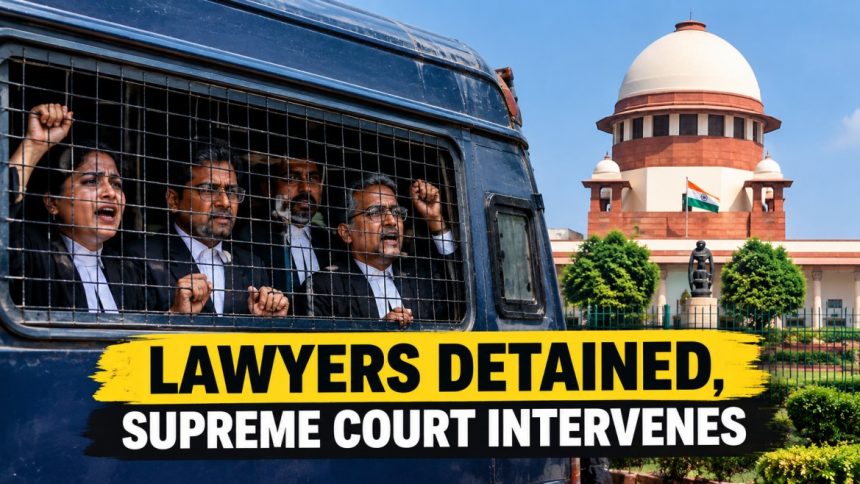
The detention of lawyers near the Supreme Court premises triggered a separate intervention on Saturday. The Supreme Court Bar Association (SCBA) approached Chief Justice of India Surya Kant, raising concerns about advocates reportedly being detained while protesting peacefully.
Following the intervention, the authorities were asked to release the detained lawyers. Approximately 50–60 advocates were subsequently released, according to media reports.
Meanwhile, a habeas corpus petition was filed in the Supreme Court seeking the production and release of Abhijeet Dipke and other detained CJP leaders. The petition also sought disclosure of their whereabouts and preservation of relevant custody records.
The Supreme Court is scheduled to hear petitions on Sunday, October 11, concerning the protest-related detentions and restrictions affecting public transport. The outcome of the hearing was not available at the time of writing.
🟡 CJP Announces ‘Chalo Jantar Mantar’ March Today
Despite Saturday’s crackdown, CJP has called on supporters to assemble again at Jantar Mantar at 10 am on Sunday.
Party organisation head Ajinkya Shinde announced the fresh mobilisation and criticised the government over the detention of party leaders, student activists and volunteers. He maintained that the agitation would continue until Chief Election Commissioner Gyanesh Kumar resigned.
The party’s principal demands include accountability over the Special Intensive Revision (SIR) of electoral rolls, protection of voting rights and changes to the process for appointing election commissioners.
CJP has also alleged that restrictions on transport, access to protest locations and communications obstructed its demonstration. These allegations have not been independently established in full.
The Students’ Federation of India and other activists have expressed solidarity with the protesters. Opposition leaders have also criticised the police action, arguing that peaceful political dissent must be protected.
🟡 Government Defends Security Measures
Delhi Police denied permission for the proposed Jantar Mantar demonstration, citing security and procedural concerns. Authorities also deployed extensive security personnel, erected barricades and restricted access to sensitive areas of the capital.
Delhi Chief Minister Rekha Gupta praised the police response, while the authorities maintained that their measures were intended to preserve law and order.
The central government and the Election Commission have faced criticism over allegations concerning voter-list revisions. The BJP and election authorities have denied allegations of wrongdoing, while maintaining that electoral-roll verification is part of the established process.
The dispute has also attracted international attention. The United Nations human rights office expressed concern over reports of mass detentions and urged Indian authorities to respect the right to peaceful assembly. India’s mission in Geneva rejected the UN criticism as unwarranted interference in the country’s internal affairs, emphasising that peaceful assembly is subject to reasonable restrictions in the interests of public order.
🟡 What Happens Next?
Sunday’s developments are likely to determine the immediate course of the confrontation. CJP is preparing to renew its mobilisation, while Delhi Police has indicated that security arrangements will remain stringent depending on the situation.
The Supreme Court proceedings could bring greater clarity to the legality of the detentions, restrictions on public movement and the status of the detained party leaders. However, no final judicial outcome on these latest petitions had been confirmed at the time of publication.
For CJP, the immediate priorities are securing the release of its remaining leaders, maintaining support for its demands and pressing for accountability over electoral-roll revisions. For the authorities, the challenge is to maintain public order while ensuring that lawful political dissent and access to legal remedies are respected.
The next phase of the CJP agitation will depend on the Supreme Court’s proceedings, the status of the detained leaders and whether the proposed Sunday march can proceed.