


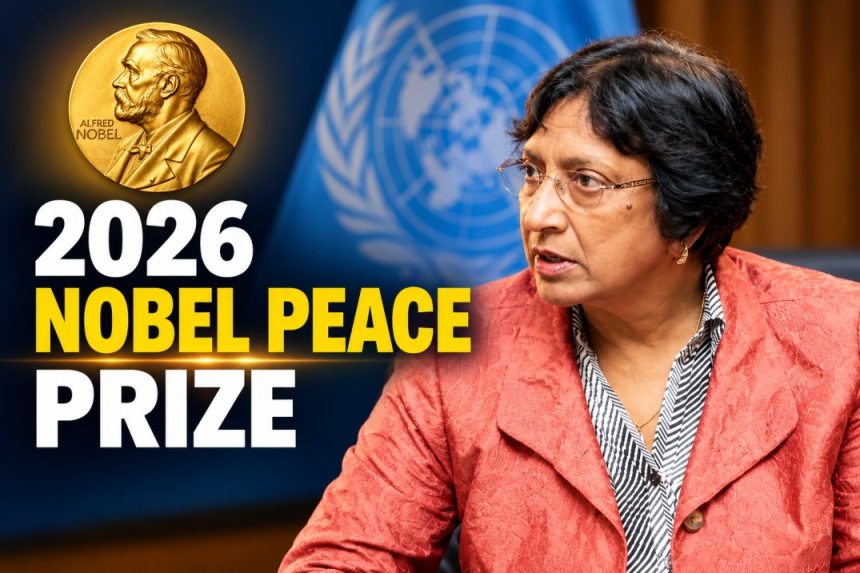
Former UN human rights chief recognised for her lifelong fight against apartheid, defence of human dignity and efforts to strengthen international law
🔴 By | PR Network
Oslo : South African jurist and former United Nations High Commissioner for Human Rights Navanethem “Navi” Pillay has been awarded the 2026 Nobel Peace Prize in recognition of her longstanding efforts to promote peace, uphold international law and strengthen accountability for serious international crimes.
The Norwegian Nobel Committee announced the award on October 9, recognising Pillay’s exceptional contribution to advancing a global legal order in which war crimes, crimes against humanity and genocide can be investigated and prosecuted. Her selection highlights the importance of human rights, independent judicial institutions and the rule of law at a time when international justice faces growing challenges.
According to the United Nations, Pillay has spent decades defending human rights and contributing to some of the most significant legal proceedings in modern international history. Her career has included fighting racial discrimination under apartheid, serving as an international judge and leading major human rights initiatives.
🟡 From Apartheid-Era South Africa to International Justice
Born in Durban, South Africa, in 1941, Pillay grew up under the apartheid system, which enforced racial segregation and discrimination. Coming from a family of Indian Tamil origin, she experienced the social realities of a system that denied equal rights to millions of people.
In 1967, she became the first woman to establish a law practice in Natal Province, South Africa. As a lawyer, she defended anti-apartheid activists and prisoners, challenged abuses in detention and worked to protect the rights of people facing political persecution.
Her career marked a significant milestone in South Africa’s legal history. In 1995, she became the first Black woman appointed to the country’s High Court, opening new possibilities for representation and equality within the judiciary.
🟡 Landmark Role in Rwanda Genocide Cases
Pillay’s contribution to international justice expanded when she joined the United Nations International Criminal Tribunal for Rwanda in 1995. The tribunal was established to prosecute individuals responsible for the 1994 Rwandan genocide and other serious violations of international humanitarian law.
She served as a judge for eight years, including four years as the tribunal’s president.
One of the most significant developments associated with her judicial work was the tribunal’s landmark 1998 judgment in the Akayesu case. The ruling recognised that rape and other forms of sexual violence could constitute genocide when committed with the intention of destroying a protected group.
The judgment became an important milestone in international criminal law, strengthening recognition of sexual violence as a potential instrument of genocide and reinforcing the principle that such crimes must not go unpunished.
🟡 Leadership at the United Nations
In September 2008, Pillay assumed office as the United Nations High Commissioner for Human Rights, a position she held until 2014.
During her tenure, she advocated for equality, the protection of vulnerable communities, accountability for human rights violations and the strengthening of international human rights standards.
She also served as a judge at the International Criminal Court, contributing to the development of international criminal justice.
Her work has consistently emphasised that human rights protections must apply universally, irrespective of nationality, political influence or the identity of those accused of wrongdoing.
🟡 Gaza Investigation and International Accountability
Pillay’s recent work has kept her at the centre of international debates over human rights and accountability.
From 2021 to 2025, she chaired the United Nations Independent International Commission of Inquiry on the Occupied Palestinian Territory, including East Jerusalem, and Israel.
In September 2025, the commission published a report concluding that Israel had committed genocide in Gaza. The report also addressed the role of senior Israeli officials. Israel rejected the allegations, which remain a subject of intense international political and legal dispute.
The commission’s findings and the broader international proceedings concerning Gaza have drawn considerable attention to questions of civilian protection, state responsibility and the enforcement of international law.
Pillay has also served as an ad hoc judge at the International Court of Justice in the case brought by The Gambia against Myanmar under the Genocide Convention, concerning allegations relating to the treatment of the Rohingya population.
🟡 Nobel Prize Highlights the Importance of the Rule of Law
The 2026 Nobel Peace Prize recognises Pillay’s longstanding efforts to strengthen international justice and promote the principle that serious crimes must be subject to legal accountability.
United Nations Secretary-General António Guterres congratulated her on the award, describing her as a steadfast and independent voice for justice. He emphasised the importance of ensuring that the force of law prevails over the law of force.
The International Commission Against the Death Penalty, where Pillay serves as president, also welcomed the announcement.
Her recognition highlights the contribution of legal professionals, judges and human rights advocates who work to ensure that justice and human dignity remain central to international relations.
For Pillay, the journey from challenging apartheid in South Africa to participating in major international legal proceedings reflects a career dedicated to the principle that no individual or authority should stand above the law.
The award also renews global attention on the role of independent courts, international institutions and human rights defenders in preventing atrocities, protecting vulnerable populations and promoting lasting peace