

🔴 By | Sonal Sharma
🟡 Europe Is Burning Again — But This Is Bigger Than One Summer
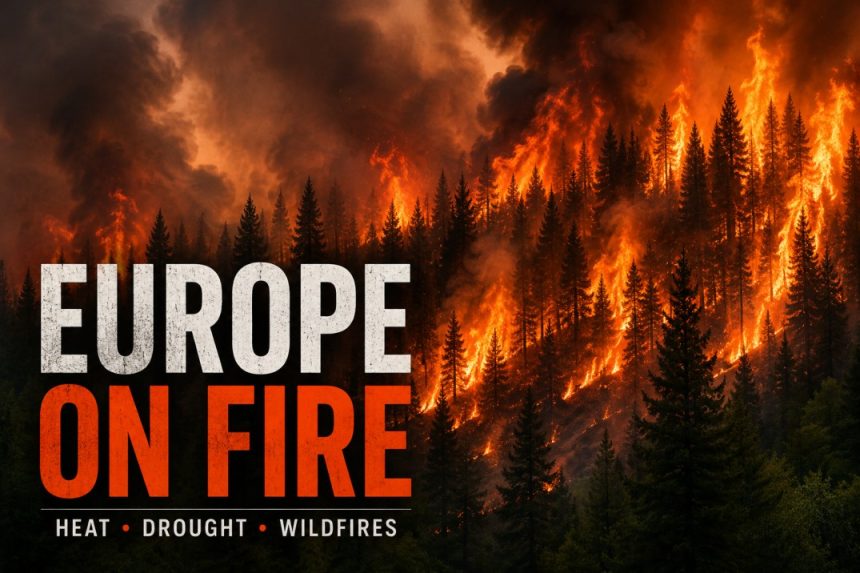
Europe is once again battling major wildfires as extreme heat, dry conditions and strong winds create dangerous fire-weather conditions across several countries. France, Spain, Portugal, Greece, Croatia, Germany and Belgium have all faced significant wildfire activity, while the spread of severe fires into parts of northern and western Europe is adding a new dimension to the continent’s long-running wildfire problem.
The immediate images are familiar: forests turning orange, residents being evacuated and firefighters battling flames under extreme heat. But the more important story lies behind those images. Europe is increasingly experiencing the combination of conditions that make wildfires spread faster, burn more intensely and become harder to control.
🟡 The Numbers Behind Europe’s Wildfire Crisis
The European Forest Fire Information System, or EFFIS, operated by the European Commission’s Joint Research Centre under the Copernicus Emergency Management Service, is one of the continent’s key wildfire-monitoring systems. Its data are based on satellite observations and focus on fires larger than 30 hectares that include at least some forested area.
The scale of the recent wildfire seasons is striking. Copernicus estimates that approximately 1,034,552 hectares were burnt across Europe in 2025, making it the largest annual burnt area in the available record. The previous record was approximately 988,524 hectares in 2017.
To put that into perspective, 1.03 million hectares is roughly 10,346 square kilometres. That is an enormous area of land lost to fire in a single year.
The 2022 season provides another warning. EFFIS recorded 1,624,381 hectares burnt across 45 observed European countries, an area roughly the size of Montenegro. Looking specifically at the European Union, 837,212 hectares were burnt in 2022, 86% more than the 449,342 hectares recorded in 2021.
The figures show why a single year’s ranking can be misleading. Different datasets cover different geographical areas, and wildfire monitoring methodologies can change. What is consistent, however, is the repeated appearance of exceptionally large fire seasons across Europe.
🟡 2025 Was a Record-Breaking Warning
The 2025 wildfire season deserves particular attention because it combined record burned area with exceptionally high fire emissions. Copernicus reported approximately 1.034 million hectares burnt across Europe, the highest annual figure in its record. Wildfire emissions also reached their highest level in the Copernicus Atmosphere Monitoring Service record, which began in 2003.
Spain and Portugal were particularly badly affected. By the end of August 2025, Spain had recorded approximately 380,877 hectares of cumulative burned area and Portugal approximately 265,139 hectares. Those figures were around 4.6 times and 3.7 times their respective averages for the same period from 2006 to 2024.
A single fire in Zamora, Spain, burned approximately 40,081 hectares, making it the country’s largest fire since records began in 1968.
These numbers demonstrate that Europe’s wildfire problem is not simply about more fires. In some circumstances, individual fires are becoming exceptionally large.
🟡 2022 Delivered Another Major Warning
The 2022 season was another landmark year. Across 45 monitored European countries, EFFIS recorded 16,941 fires covering 1,624,381 hectares. Spain alone accounted for approximately 315,705 hectares, while Romania, Portugal, Bosnia and Herzegovina and France were also among the countries most affected.
The environmental damage extended into protected ecosystems. Approximately 365,308 hectares of Natura 2000 protected areas were affected by fire in 2022, the highest amount mapped in those protected areas over the preceding decade.
The European Commission has also noted that around 96% of fires are associated with human actions, while climate-driven increases in fire danger can make those ignitions far more difficult to contain. This distinction is critical: climate change does not have to start a fire to make a wildfire disaster more likely.
🟡 Heat Alone Does Not Explain a Wildfire
There is a tendency to describe every major wildfire simply as a consequence of extreme temperature. The reality is more complicated.
A fire requires an ignition source, but whether that ignition becomes a major wildfire depends heavily on environmental conditions. High temperatures dry vegetation. Lack of rainfall reduces soil moisture. Prolonged drought turns grass, leaves, shrubs and dead vegetation into highly combustible fuel. Strong winds then help the flames spread and can carry burning embers far beyond the main fire front.
This is why scientists often talk about fire weather rather than temperature alone. Copernicus uses the Fire Weather Index to assess weather conditions affecting fuel flammability and potential fire spread. Temperature, humidity, wind and dryness all contribute to the overall danger.
🟡 The Climate Change Connection
The strongest scientific argument is not that climate change directly causes every wildfire. It is that climate change is altering the background conditions in which wildfires occur.
Europe is the world’s fastest-warming continent, according to the Copernicus European State of the Climate assessment. In 2025, at least 95% of Europe experienced above-average annual temperatures, while large parts of the continent experienced severe heatwaves. Copernicus also linked hot and dry conditions with the record wildfire activity recorded that year.
As the baseline temperature rises, extreme heat can occur on top of an already warmer climate. When that heat coincides with prolonged drought and dry vegetation, the landscape becomes increasingly vulnerable to rapid fire spread.
That is the more meaningful climate connection: warming increases the likelihood of the environmental conditions that allow extreme wildfires to develop.
🟡 Europe’s Fire Season Is Becoming More Dangerous
Another concern is the geographical spread of serious wildfire conditions.
Southern Europe has always been vulnerable to summer fires, particularly in Mediterranean countries. But recent events demonstrate that extreme wildfire conditions are no longer confined to the traditional Mediterranean fire belt.
In 2025, countries including the United Kingdom, the Netherlands and Germany recorded their highest annual wildfire emissions in the Copernicus record.
The significance is not that northern Europe will suddenly experience the same wildfire climate as southern Spain or Greece. Rather, regions that historically experienced comparatively lower wildfire risk can also face dangerous conditions when heat, dryness and wind combine.
🟡 The Human Cost Is Beyond Burned Hectares
Every burned hectare represents more than a number on a satellite map.
Wildfires can destroy homes, agricultural land, roads and electricity infrastructure. They can force large-scale evacuations, disrupt tourism and place enormous pressure on firefighters and emergency services.
The environmental consequences can be even longer-lasting. Forest fires destroy habitats, reduce biodiversity and degrade ecosystems. When fires affect protected areas, the damage can extend to species and habitats that may take decades to recover.
In 2022, the approximately 365,308 hectares of Natura 2000 protected areas affected by fire demonstrated how severely wildfire can penetrate Europe’s most important biodiversity zones.
🟡 Wildfires Are Also Becoming a Climate Problem
There is another side to the equation.
Wildfires release carbon dioxide and other pollutants into the atmosphere. Copernicus reported that Europe’s wildfire emissions reached their highest level on record in 2025. Spain alone contributed around half of Europe’s total wildfire emissions that year.
This creates a complicated feedback. Hotter and drier conditions can increase wildfire risk, while large fires release stored carbon and degrade ecosystems that otherwise help absorb carbon from the atmosphere.
The contribution of wildfire emissions to Europe’s total human-caused emissions remains comparatively limited, but their impact on local air quality, ecosystems and climate-sensitive carbon stores can be substantial.
🟡 The Real Warning Is in the Pattern
The most important conclusion does not come from one year’s record.
It comes from the recurrence of extreme seasons.
Europe recorded approximately 988,524 hectares burnt in 2017, 1,624,381 hectares across 45 monitored countries in 2022, and approximately 1,034,552 hectares across Europe in 2025. These figures are not perfectly comparable because their geographic coverage and methodology differ, but they demonstrate the repeated occurrence of exceptionally large wildfire seasons.
The pattern suggests that Europe cannot treat every extreme wildfire season as an isolated disaster.
🟡 What Happens Next?
The challenge for European governments is therefore shifting from simply responding to fires to preventing extreme fire conditions from turning ignitions into catastrophes.
That means better forest management, early-warning systems, satellite monitoring, rapid deployment of firefighting resources, protection of communities located near forests and stronger coordination between neighbouring countries.
Climate adaptation will also become increasingly important. If summers become hotter and drought periods become longer, traditional assumptions about when and where wildfire risk is highest may no longer be sufficient.
🟡 The Bottom Line
Europe’s wildfire crisis is not simply a story about a hot summer.
It is the result of a dangerous combination of rising temperatures, prolonged dryness, drought, low vegetation moisture, strong winds and human or natural ignition sources.
The 2025 record of approximately 1.03 million hectares burnt across Europe is already a major warning. The 2022 figure of more than 1.62 million hectares across 45 monitored countries shows that extreme seasons can be dramatically larger. And the repeated appearance of such events suggests that Europe’s wildfire risk is becoming a structural climate challenge rather than an occasional summer emergency.
The flames are the visible disaster. The deeper story is the changing environment that allows those flames to spread.