

🔴 By | Arvind Jadhav
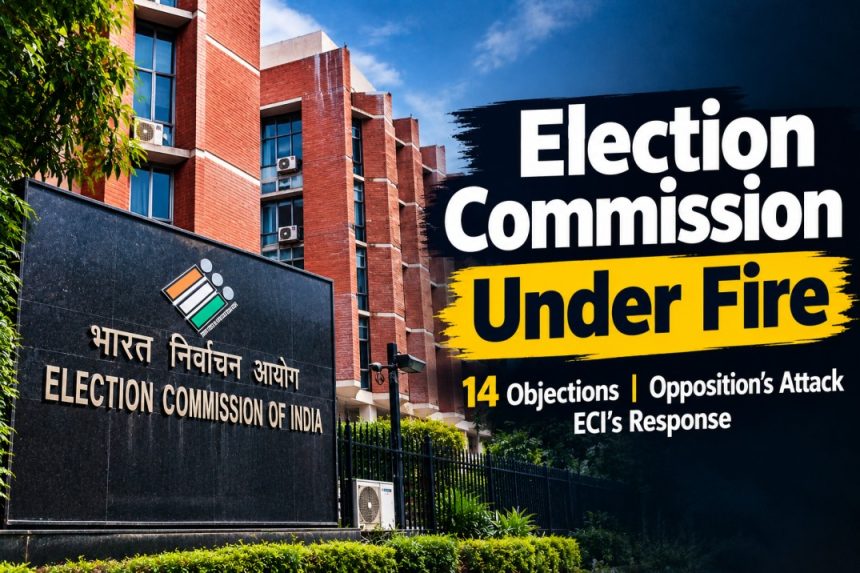
New Delhi: The Election Commission of India has come under renewed political scrutiny following an investigation by The Indian Express which reported that Election Commissioners Sukhbir Singh Sandhu and Vivek Joshi raised written objections on at least 14 occasions over the past 10 months on various decisions concerning electoral rolls and the functioning of the poll panel.
According to the report, the objections related to issues including the addition and deletion of names from electoral rolls, registration of new voters, changes in Form 6 and the handling and centralisation of electoral-roll data. The report has triggered fresh questions from opposition parties over the transparency of the Election Commission’s internal decision-making process.
🟡 Questions Over Electoral Roll Changes
The Indian Express investigation reported that the two Election Commissioners raised concerns over certain changes made to the process for registering new voters. One of the issues involved additional information being sought through Form 6 regarding whether an applicant or their parents or grandparents were listed in earlier electoral rolls.
According to the report, Sukhbir Singh Sandhu had, in one of his written objections, described a particular action as “unauthorised and illegal.” The investigation also reported concerns among the commissioners over the gradual centralisation of electoral-roll data and its implications for officials handling the electoral process at the state and local levels.
🟡 Opposition Steps Up Attack
The report has prompted strong reactions from several opposition parties.
Congress leaders have questioned how major decisions could proceed when members of the Commission had reportedly recorded objections. Congress MP Manish Tewari questioned whether there was an external influence over the functioning of the poll panel and raised the issue of accountability within the constitutional institution.
Senior Congress leader P. Chidambaram also called for scrutiny of the reported objections and questioned the continuation of the Special Intensive Revision process if the concerns mentioned in the report were substantiated.
Other opposition parties have also joined the criticism. Leaders of the Trinamool Congress, Samajwadi Party, Aam Aadmi Party and CPI(M) have raised questions over Chief Election Commissioner Gyanesh Kumar’s functioning and demanded greater transparency in the Commission’s decisions.
🟡 Uddhav Thackeray Demands Action
Shiv Sena (UBT) chief Uddhav Thackeray also reacted strongly to the report and demanded action against Chief Election Commissioner Gyanesh Kumar.
Thackeray linked the reported objections to questions earlier raised by opposition parties over electoral processes and also questioned the conduct of recent Assembly elections. He reiterated his demand for greater transparency in elections and advocated a return to ballot papers.
These are political allegations and demands made by opposition leaders and should be distinguished from independently established findings.
🟡 Election Commission Rejects Impression of Internal Breakdown
The Election Commission, however, has rejected the suggestion that the reported objections indicate a breakdown or paralysis within the institution.
The Commission said that differences of opinion, suggestions and observations during internal deliberations are normal in a multi-member constitutional body. According to the ECI, comments or objections recorded during the process of preparing a decision should not be confused with the final decision of the Commission.
The poll panel has maintained that important decisions taken during the period, including those relating to the Special Intensive Revision, were ultimately approved unanimously by the full Commission and that official orders were issued according to the prescribed legal procedure.
🟡 The Bigger Question
The controversy has therefore moved beyond the reported 14 objections and raised a broader question about how India’s election machinery takes important decisions.
The key issues now include what exactly the two Election Commissioners objected to, how those objections were dealt with before final decisions were taken, and how electoral-roll data is being managed between central, state and local authorities.
With opposition parties demanding greater accountability and the Election Commission maintaining that its final decisions were unanimous, the controversy has put the poll panel’s internal decision-making and electoral-roll management under renewed public scrutiny.