


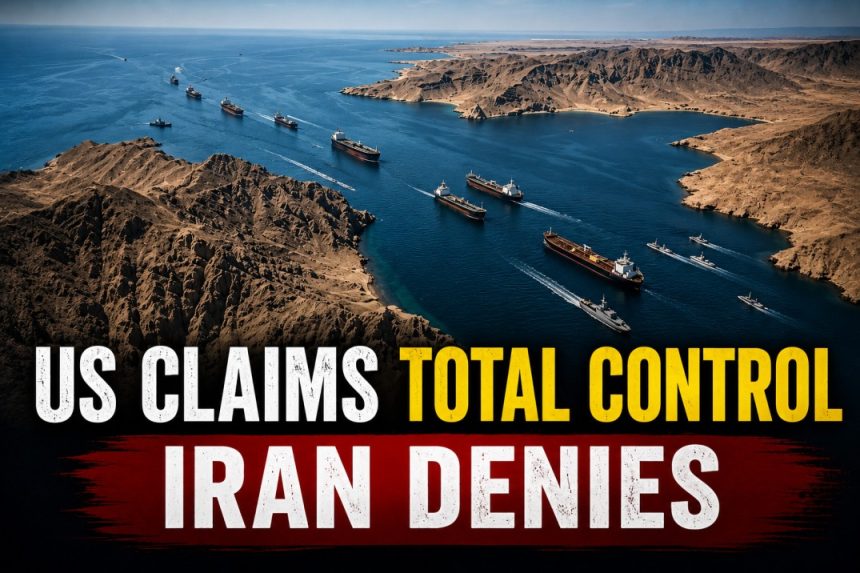
US-Iran tensions deepen as Washington claims control over the strategic waterway, while Tehran strongly disputes the assertion
🔴 By | Arvind Jadhav
US President Donald Trump has claimed that the United States has “total control” of the Strait of Hormuz, one of the world’s most strategically important maritime routes. Trump’s remarks come amid continuing tensions between Washington and Tehran and growing uncertainty over the future of shipping through the vital waterway.
🟡 Iran Rejects Trump’s Claim
Iran has rejected Trump’s assertion that the United States has complete control over the Strait of Hormuz. Tehran maintains that Washington’s statement does not reflect the situation on the ground and that the strategic waterway cannot simply be declared under US control.
Iran has also indicated that any restoration of normal maritime traffic would depend on developments in the wider US-Iran confrontation and negotiations between the two sides.
🟡 Shipping Traffic Falls Sharply
The dispute comes as commercial shipping through the Strait of Hormuz has fallen dramatically. Reports indicate that only a small number of vessels have recently crossed the waterway, compared with more than a hundred vessels a day before the current crisis.
The sharp decline has raised concerns among international shipping companies and energy markets, given the Strait’s crucial role in global oil and gas transportation.
🟡 US-Iran Talks Hit Another Roadblock
Trump’s latest remarks come as diplomatic efforts between Washington and Tehran have again run into difficulties. Negotiations aimed at reducing tensions, establishing a durable ceasefire and restoring maritime traffic have yet to produce a comprehensive agreement.
The issue of who controls or guarantees safe passage through the Strait of Hormuz has emerged as one of the most sensitive points in the negotiations.
🟡 Why the Strait of Hormuz Matters
The Strait of Hormuz connects the Persian Gulf with the Gulf of Oman and the Arabian Sea. It is a critical route for global energy supplies, making any prolonged disruption a potential threat to international oil markets.
A continued reduction in shipping could push up crude oil prices, increase transportation costs and put additional pressure on fuel prices and inflation in countries that depend heavily on imported energy.
🟡 Two Contrasting Claims
While Trump says the United States has established “total control” over the strategic waterway, Iran strongly rejects the claim. The sharp difference between the two positions highlights the continuing military and diplomatic confrontation between Washington and Tehran.
For now, the key question is whether negotiations can produce an arrangement that allows commercial shipping to resume safely and restores stability around one of the world’s most important energy corridors.