

🔴 By | Sonal Sharma
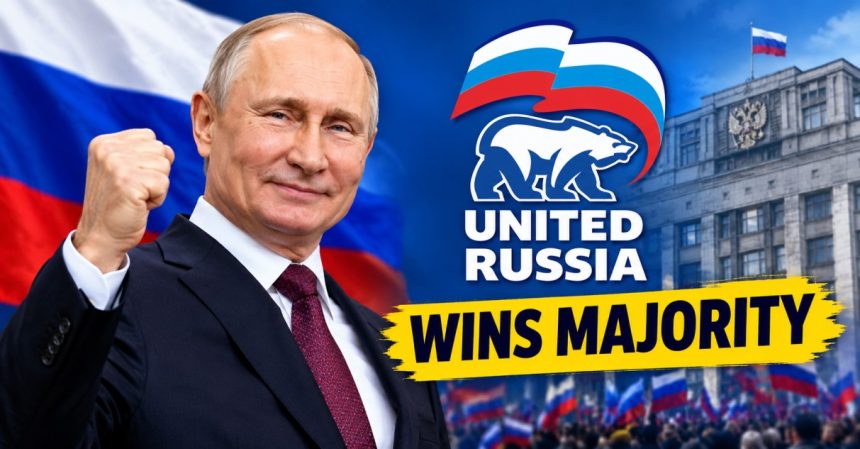
Moscow: Russia’s ruling United Russia party has secured a commanding majority in the country’s parliamentary election, strengthening President Vladimir Putin’s political position as the country continues to deal with the war in Ukraine and growing tensions with Western nations.
According to the preliminary results, United Russia secured around 57.8% of the party-list vote after more than 95% of ballots had been counted. The party is expected to control 355 of the 450 seats in Russia’s State Duma.
🟡 United Russia increases its strength
The latest result represents a significant increase compared with the previous parliamentary election. United Russia had won about 49.8% of the party-list vote in 2021 and held 326 seats in the State Duma.
The new parliamentary strength gives the party a constitutional supermajority, allowing it to pass major legislation with limited dependence on other parliamentary groups.
Other parties also crossed the threshold required for representation. The Communist Party is projected to have 40 seats, while the Liberal Democratic Party is expected to secure 25 seats. New People is projected to receive 20 seats, with A Just Russia taking four seats.
🟡 Election held amid the Ukraine war
The election took place from September 18 to 20, 2026, and was the first parliamentary election held in Russia since the beginning of the full-scale Ukraine war in 2022.
The outcome is being closely watched because the election provides an indication of the level of support for Putin’s government and its policies during a prolonged period of military conflict and international pressure.
Overall voter turnout was reported at around 59%, with millions of voters also using Russia’s electronic voting system.
🟡 Opposition raises concerns
The election has also generated controversy over the participation of opposition groups and candidates. Several anti-war political figures and opposition candidates were unable to contest the election, while critics questioned whether voters were given a sufficiently broad range of political choices.
Russian authorities have defended the electoral process and maintained that the election was conducted according to the country’s laws.
Voting in occupied Ukrainian territories
Another major issue surrounding the election was voting in Ukrainian territories that Russia claims to have annexed.
Voting was conducted in areas of Donetsk, Luhansk, Kherson and Zaporizhzhia, as well as Crimea. Ukraine and several Western governments have rejected Russia’s territorial claims and said they do not recognise elections held in those areas.
🟡 Major boost for the Kremlin
The parliamentary result gives United Russia a much larger presence in the State Duma and provides the Kremlin with strong legislative support.
With 355 seats in the 450-member chamber, the party will have substantial control over the legislative process. The result could therefore have an important impact on Russia’s domestic policies, economic measures and decisions connected with the continuing war.
The final electoral procedures and official confirmation of all results will determine the complete composition of the new State Duma.
For Putin and the Kremlin, however, the preliminary result already represents a significant parliamentary mandate at a time when Russia remains under international sanctions and faces continuing geopolitical pressure.